
A sonohysterogram (SHG), also called saline infusion sonography (SIS) or a saline sonogram, uses transvaginal ultrasound and sterile saline to evaluate the uterine cavity and identify abnormalities that may affect fertility, including polyps, fibroids, scar tissue, or differences in uterine shape.
At Illume Fertility, SHG is included as part of the standard female fertility evaluation and is completed alongside a hysterosalpingogram (HSG). Because the two tests evaluate different aspects of reproductive anatomy, your physician reviews both results together with the rest of your fertility testing to build a more complete picture and guide next steps.
Schedule Your Consult Download Testing WorkbookWhat you should know before your appointment.

Polyps, fibroids, scar tissue, uterine shape, and other findings that may affect the inside of the uterine cavity.

Typically on Cycle Days 5–10, after menstrual bleeding has ended and before ovulation, based on your Care Team's instructions.

Sterile saline gently expands the uterine cavity while a transvaginal ultrasound creates detailed images of the lining and cavity.

Your physician reviews your SHG alongside your HSG and other fertility test results to determine the best path forward.
Disclaimer: This content is provided for educational purposes only. It should not be used to diagnose or treat any condition. Always consult your healthcare provider for personalized medical guidance.
A standard transvaginal ultrasound provides important information about the uterus and ovaries, but the walls of the uterine cavity normally rest against each other. This can make some abnormalities inside the cavity more difficult to see.
During an SHG, a small amount of sterile saline is introduced into the uterus through a thin catheter. The saline gently separates the uterine walls, allowing ultrasound to create a clearer view of the cavity and endometrial lining.
This detailed view can help identify findings such as polyps, fibroids, scar tissue (adhesions), or differences in the shape of the uterine cavity. ASRM notes that SHG provides a more detailed assessment of the uterine cavity than HSG for detecting many intrauterine abnormalities.
Your physician will interpret the findings alongside your HSG, medical history, ultrasound findings, and other fertility testing.
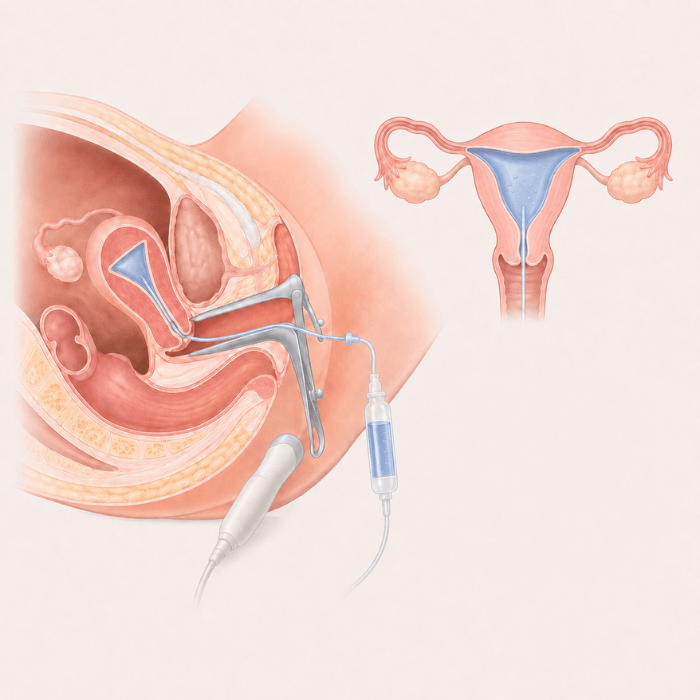
An SHG begins much like a transvaginal ultrasound. A speculum is placed so your provider can see the cervix, and a thin catheter is passed through the cervix into the uterus.
The speculum is removed, the ultrasound probe is positioned, and sterile saline is slowly introduced through the catheter while your provider views the uterine cavity in real time.
Some patients experience mild pressure or menstrual-like cramping as the catheter is placed or saline enters the uterus. Experiences vary, so tell your Care Team beforehand if you are concerned about discomfort or anxiety. SHG is generally well tolerated, and most patients can resume normal activities afterward.
The procedure itself is brief. At Illume, an SHG is generally completed in about 15 minutes.
Read Full SHG Guide
SHG testing may be covered by insurance when ordered as part of a fertility evaluation, but your exact coverage and out-of-pocket responsibility will depend on your individual plan.
For patients paying out of pocket, an SHG typically costs between $400 and $800. Other blood work, ultrasounds, consultations, or diagnostic services included in your fertility evaluation may incur separate costs.
Before testing begins, your Illume Fertility financial coordinator will verify your benefits, review your expected deductible, copay, or coinsurance, and help you understand your anticipated costs.
Note: Price ranges are estimates only and are not a guarantee of Illume Fertility's current pricing. Actual costs may vary based on the services performed and your insurance coverage.

Schedule Your Consult Download Testing Workbook
At Illume Fertility, both tests are included in the standard female fertility evaluation because each provides different information about your reproductive anatomy.
Outlines the uterine cavity and provides information about its overall shape and structure.
Shows whether contrast can pass through each fallopian tube, helping identify a possible blockage.
Provides tubal findings that can influence which fertility treatment options your physician recommends.
Uses sterile saline and ultrasound to create a detailed view of the inside of the uterine cavity.
Helps identify polyps, fibroids, scar tissue, or other abnormalities that may affect the uterine cavity.
Adds detailed uterine information that helps your physician develop a more complete, personalized treatment plan.
Learn about other testing that may be included in your fertility evaluation.

During an SHG, sterile saline is introduced into the uterus through a thin catheter while transvaginal ultrasound creates detailed images of the uterine cavity and lining.
The procedure begins with a transvaginal ultrasound. A speculum is then placed so your provider can see the cervix, and a small catheter is passed through the cervix into the uterus. The speculum is removed, the ultrasound probe is repositioned, and saline is slowly introduced while your provider examines the uterine cavity in real time.
The test itself is typically completed in about 15 minutes, although your total appointment may be slightly longer for preparation and discussion.
For a more detailed walkthrough, read Illume’s guide to what to expect before, during, and after a saline sonogram.
Source: ACOG
An SHG can help identify structural abnormalities inside the uterine cavity, including endometrial polyps, submucosal fibroids, scar tissue or adhesions, and differences in uterine cavity shape.
Introducing saline gently separates the uterine walls, which makes abnormalities that project into or alter the cavity easier to see than with standard transvaginal ultrasound alone.
For more context on why uterine evaluation is included in the workup, explore Illume’s complete fertility testing process.
An SHG can cause cramping or discomfort, but the experience varies from person to person. Some patients feel only mild pressure, while others experience more noticeable menstrual-like cramping as the catheter is placed or saline enters the uterus.
It is also completely reasonable to feel nervous about the procedure. If pelvic exams have been painful for you in the past, you have a history of pelvic pain or trauma, or you are worried about discomfort for any reason, always tell your Care Team beforehand. They can explain what to expect, discuss pain-management options, and check in with you throughout the procedure.
Read Illume’s patient-focused SHG guide for more about the experience.
An SHG is usually performed after your menstrual period has ended but before ovulation. At Illume Fertility, SHG testing is typically scheduled on Cycle Days 5–10.
This timing allows the uterine lining to be evaluated when it is relatively thin and also helps avoid performing the procedure during an early pregnancy. Your Care Team will give you specific scheduling instructions based on your cycle.
If you are unsure which day counts as "Cycle Day 1," Illume defines it as the first day of full menstrual flow, not light spotting.
Most patients can return to their usual activities after an SHG. Mild cramping, light spotting, or watery vaginal discharge as the saline leaves the uterus can occur after the procedure.
These symptoms should generally improve rather than become more severe. Contact your Care Team if you develop fever, increasing or severe pelvic pain, heavy bleeding, or other symptoms that concern you.
Illume’s saline sonogram guide also provides more detail on what to expect after the procedure.
A standard SHG cannot reliably determine whether each individual fallopian tube is open. A hysterosalpingogram (HSG) is typically used to evaluate tubal patency.
Fluid seen outside the uterus during an SHG may suggest that at least one fallopian tube is open, but standard SHG does not reliably show which tube the fluid passed through.
ASRM distinguishes SHG as a detailed uterine-cavity test and HSG as a test used to document whether individual fallopian tubes are open or blocked.
Learn how Illume evaluates the fallopian tubes with an HSG test.
No. An SHG cannot diagnose endometriosis because it evaluates the inside of the uterine cavity, while endometriosis develops outside the uterine cavity.
A normal SHG therefore does not rule out endometriosis. If your symptoms or medical history raise concern for endometriosis, your fertility specialist may recommend a different evaluation based on your individual circumstances.
Learn more in Illume’s guide to endometriosis and fertility and ASRM’s endometriosis patient education booklet.
A normal SHG means no significant abnormality was identified within the uterine cavity. If the test identifies a structural finding, your physician will determine whether it needs further evaluation or treatment.
Not every abnormal finding will affect fertility or require intervention. Your physician will consider its size, location, appearance, your reproductive history, and your treatment plans before recommending next steps.
In some cases, hysteroscopy may be recommended. Unlike SHG, which creates ultrasound images of the cavity, hysteroscopy allows the physician to look directly inside the uterus and can also be used to treat certain abnormalities.
ASRM identifies hysteroscopy as the definitive method for diagnosing and treating intrauterine pathology. Read ASRM’s guidance on uterine cavity evaluation.
Learn more about hysteroscopy and other fertility surgeries offered at Illume.
At Illume, your SHG is interpreted as one piece of a complete fertility evaluation. Your physician considers what the imaging shows about your uterine cavity alongside your HSG, ultrasound findings, hormone testing, medical history, and reproductive goals.
If the test identifies a polyp, fibroid, scar tissue, or another finding, your Care Team will explain what it may mean for your fertility and whether additional evaluation or treatment is recommended.
Schedule Your Consult Download Testing Workbook