Explore your chances of IVF success at Illume Fertility using the latest data reported to the Society for Assisted Reproductive Technology (SART), the organization that independently tracks and publishes IVF outcomes from fertility clinics across the United States to help patients make informed decisions.
Updated January 2026. Success rates reflect finalized 2022 SART data.
Schedule Your Consult How Illume Compares
Since 2002, Illume Fertility has been internationally recognized as a leading fertility clinic that prioritizes patient success.
Utilizing a comprehensive care model and the most advanced reproductive technologies performed in our state-of-the-art facilities, Illume's award-winning team of physicians and embryologists have helped families welcome more than 18,000 babies into the world.
A trusted expert in inclusive family-building care, Illume Fertility serves individuals and couples across the Tri-State Area (New York, Connecticut, and New Jersey), throughout the United States, and internationally, helping a diverse range of hopeful patients achieve their dreams of parenthood.
We are proud to share our most recent in vitro fertilization (IVF) success rate results as reported by the Society for Assisted Reproductive Technology (SART).
View Success Rates Read FAQs
A comparison of clinic success rates may not be meaningful because patient medical characteristics, treatment approaches, and entry criteria for ART vary from clinic to clinic.
View SART Clinic Summary Report for 2022
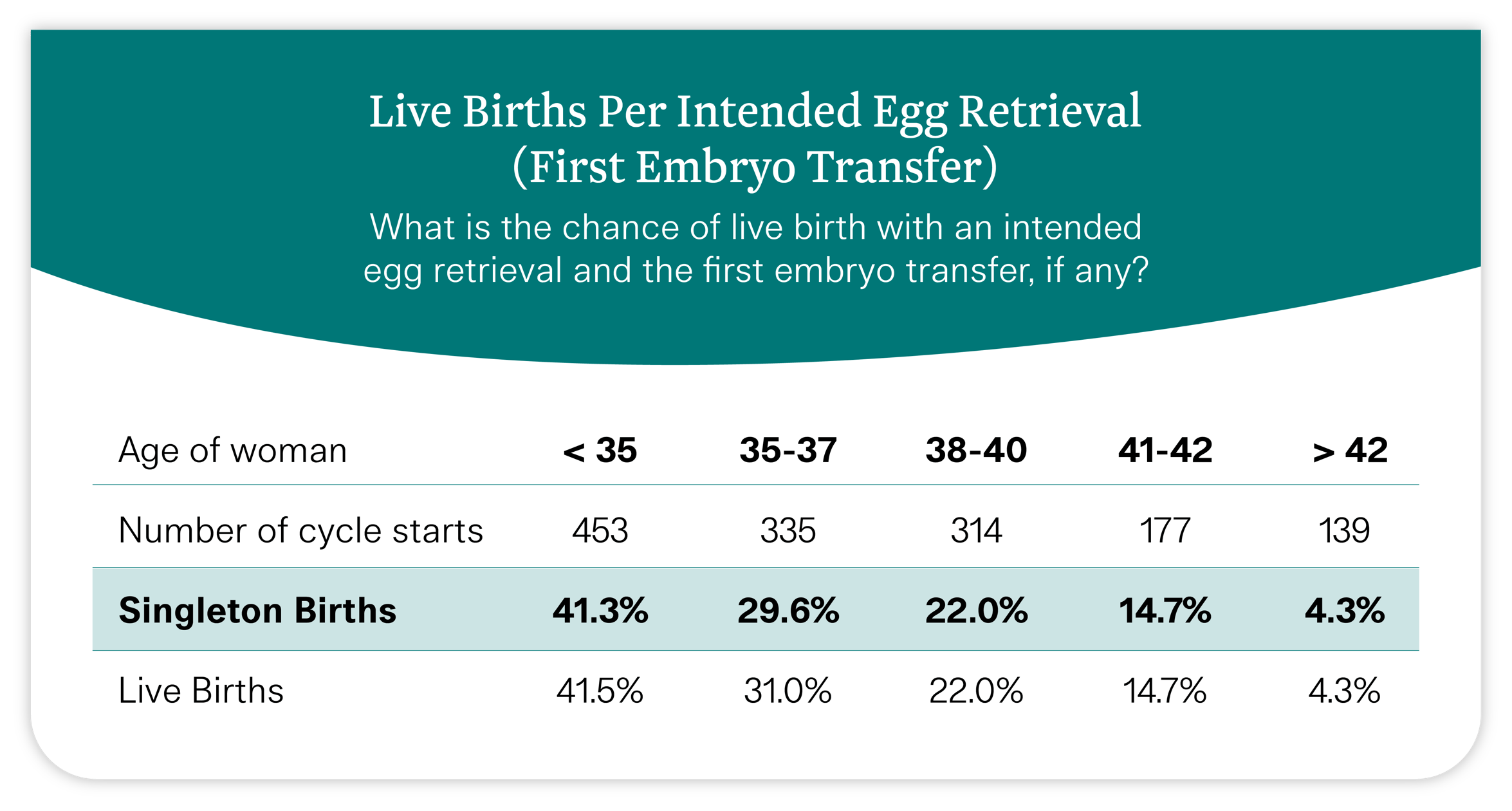
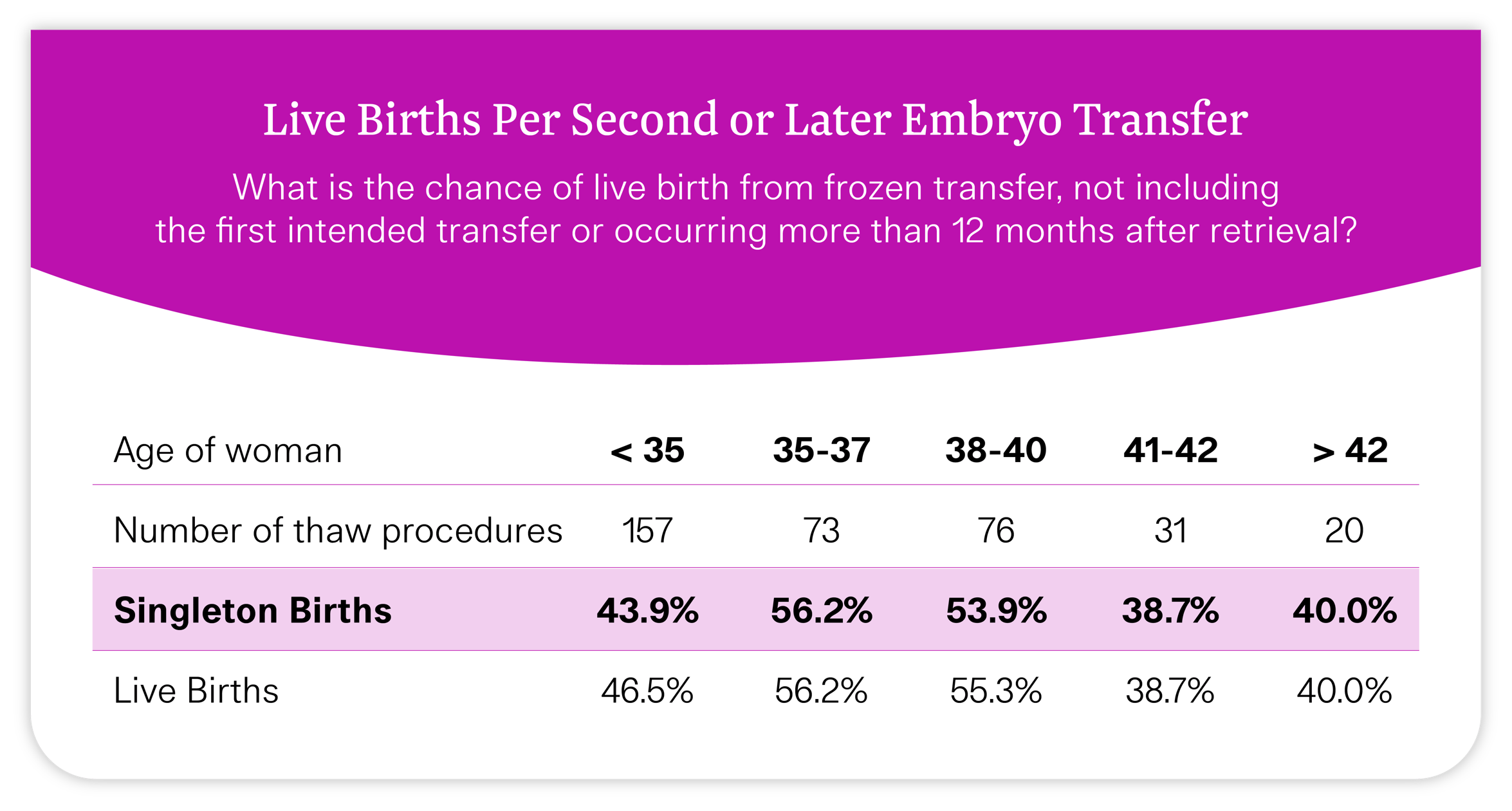
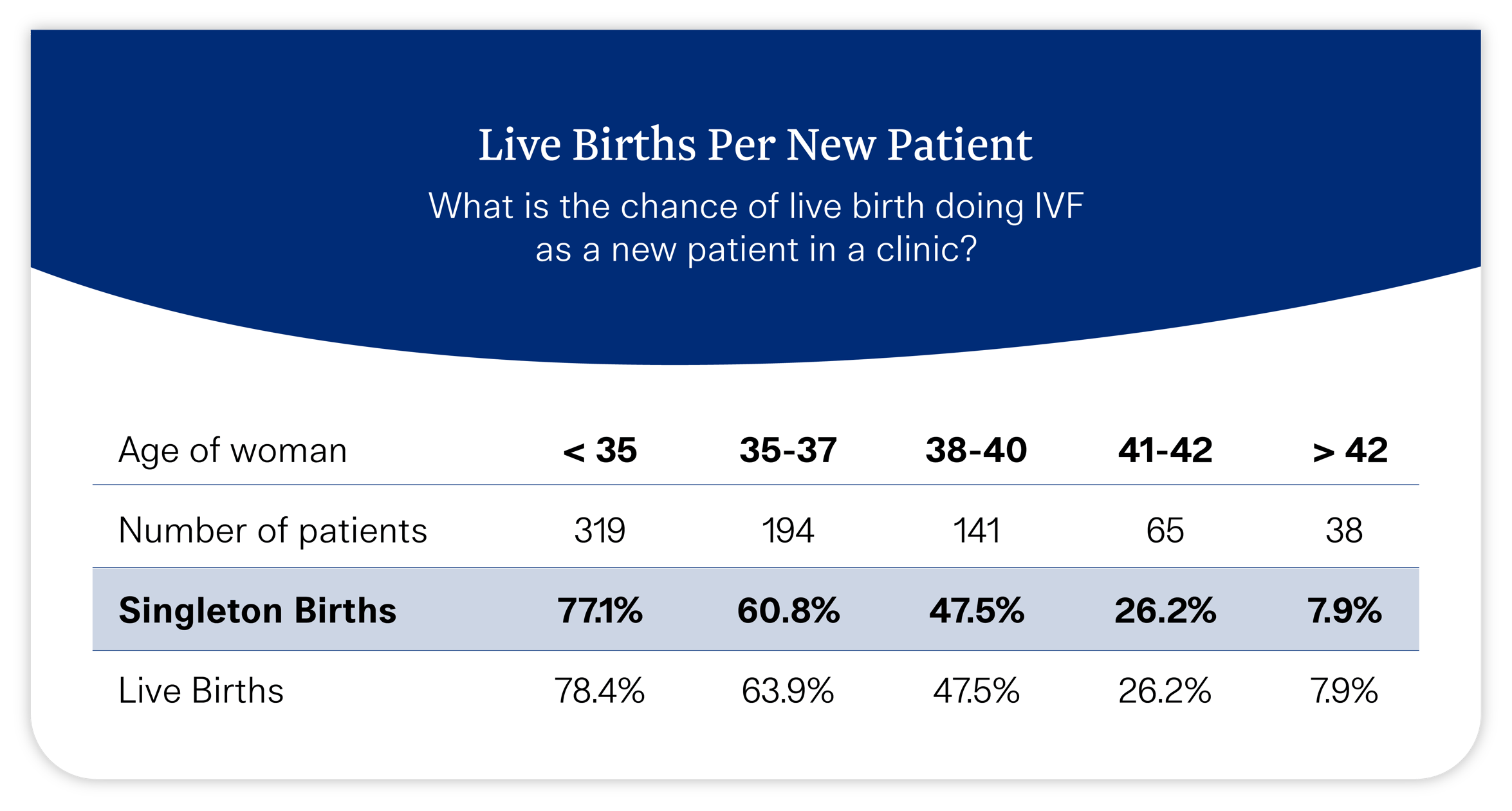
Our success rates are consistently higher than the national average* across nearly all age groups when looking at the likelihood of having a baby through IVF using your own eggs.
Our fertility specialists are here to help you understand your personal chances of success and explore your options.
*A comparison of clinic success rates may not be meaningful because patient medical characteristics, treatment plans, and entry criteria for IVF vary by clinic.

Talk to An Expert Meet Our Team
Understanding IVF success rate reports can be confusing. Here are some simple explanations of terms you'll encounter to help you feel more confident interpreting SART data.

The percentage of IVF patients or cycles that result in the delivery of a baby. SART uses this as the main way to measure IVF success.

This means a cycle where medication was started with the goal of retrieving eggs, even if the retrieval did not happen.

This looks at a person’s overall chance of success during their treatment at a fertility clinic, not just one single IVF attempt.

This refers to a person's chances of success for one treatment attempt, such as one egg retrieval or IVF embryo transfer.

The chance of having a baby after multiple in vitro fertilization (IVF) cycles. Success rates typically increase over time.

A fresh transfer occurs shortly after retrieval. A frozen transfer happens later using a frozen embryo. SART reports these separately.

Brittany & Fletcher
Christa & Aland
Maureen & Melissa
Shiraine & Barry
Jennifer & Alex
Adeel & Anthony
Explore the most common questions about fertility treatment success rates, how to interpret the scientific data, and where to turn for more answers.
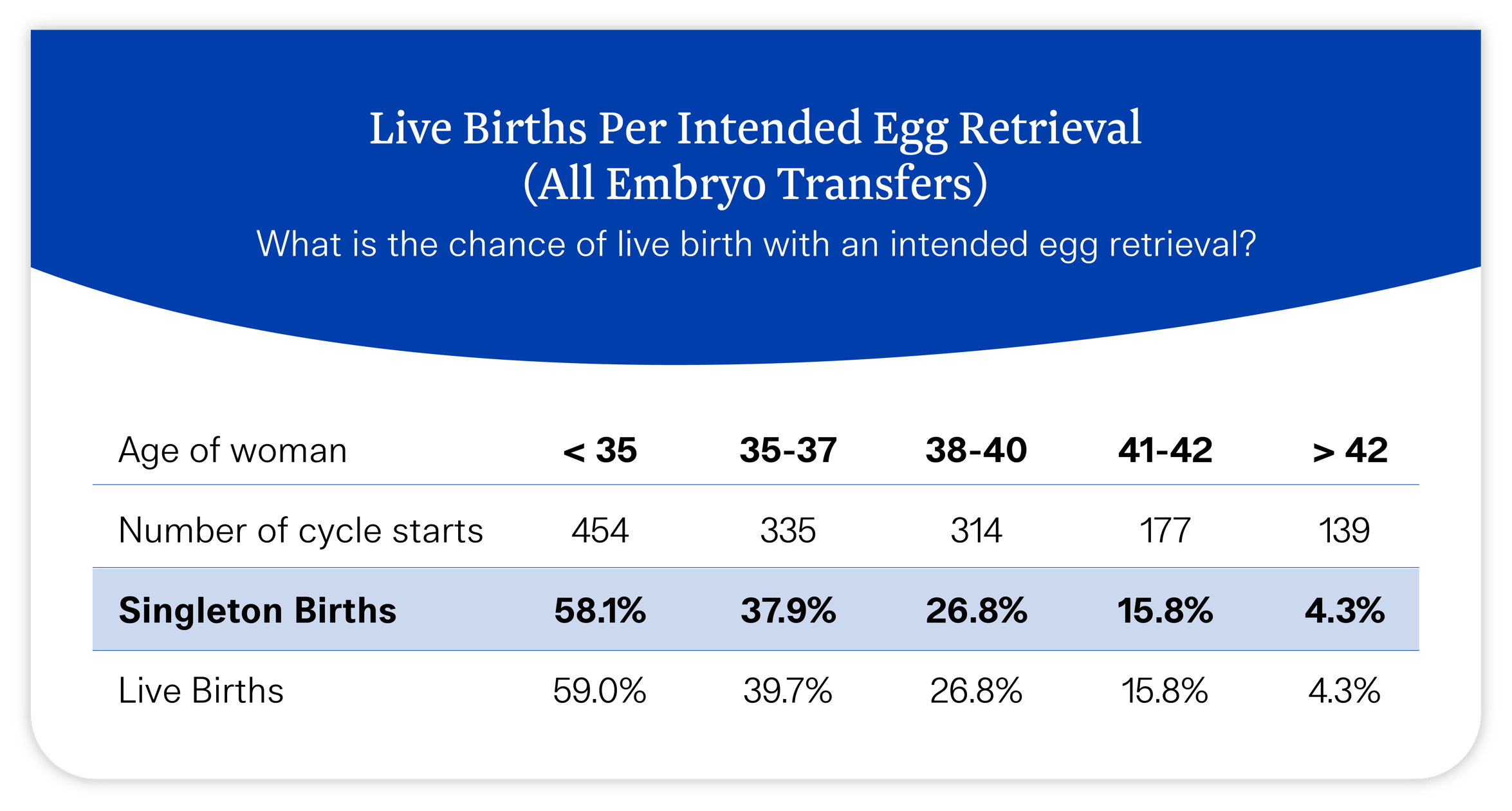
The data below comes directly from our 2022 SART Clinic Summary Report, which reflects outcomes from IVF treatment performed at Illume Fertility during that reporting period.
You may notice that success rate data typically lags behind the current year. That’s because it takes time for treatment cycles to be fully completed and reported. For example, some patients choose to freeze embryos and transfer later, and pregnancy and delivery naturally take many months. Using finalized SART data ensures accuracy and transparency.
(All embryo transfers using the patient’s own eggs.)
This statistic shows the chance of having a live singleton birth after starting an IVF cycle with the goal of retrieving eggs — and completing any embryo transfer(s) from that retrieval.
Because this metric includes every transfer from a single retrieval, it reflects the full potential of one IVF cycle — not just the first embryo transfer. These percentages include patients whose cycles may have been canceled or resulted in no eggs retrieved, and they account for all embryo transfers from a given retrieval (fresh and frozen).
The number of live singleton births per new patient using their own eggs at Illume Fertility (in other words, the odds of having a baby using your own eggs doing IVF as a new patient at our practice) are as follows:
These percentages reflect the likelihood of a live birth after beginning IVF treatment at Illume Fertility, not just a single embryo transfer.
Disclaimer: A comparison of clinic success rates may not be meaningful because patient medical characteristics, treatment approaches, and entry criteria for ART may vary from clinic to clinic. You can find the latest statistics on SART’s website.
(Based on the 2022 SART Clinic Summary Report for patients using their own eggs, measured as live births per new IVF patient.)
IVF success rates vary by age. According to national data reported to the Society for Assisted Reproductive Technology (SART), the average chance of having a baby per new IVF patient in 2022 was approximately:
• Under 35: about 69%
• Age 35–37: about 59%
• Age 38–40: about 43%
• Age 41–42: about 24%
• Age 43+: about 8%
These numbers reflect the overall likelihood of a live birth once a patient begins IVF treatment at a clinic, not just a single cycle or transfer. Success rates are highest in younger age groups and naturally decrease with age.
Disclaimer: A comparison of clinic success rates may not be meaningful because patient medical characteristics, treatment approaches, and entry criteria for ART may vary from clinic to clinic. You can find the latest statistics on SART’s website.
Illume Fertility’s IVF success rates are consistently higher than national averages across most age groups. This includes patients under 35 as well as patients in older age brackets, where the difference between average and above-average care can be especially meaningful.
While numbers matter, so does context.
Success depends on many factors including age, egg and sperm quality, diagnosis, treatment protocol, underlying health conditions, and more. That is why our Care Team personalizes every treatment plan and works closely with each patient to maximize their chances of success.
While we wish there were a straightforward answer to this question, the truth is that it depends on your age and medical situation. Some patients have a successful outcome from their first IVF cycle, while others need more than one cycle to achieve a live birth.
National SART data shows that live birth rates per new IVF patient vary significantly by age, with higher success rates at younger ages and lower success rates as age increases.
Your doctor will help you understand what a realistic success rate looks like for you.
Many patients will need more than one IVF retrieval or transfer before having a baby. This is completely normal and expected in fertility care.
Studies show that cumulative success rates increase over multiple cycles, meaning the chance of success grows as treatment continues. Your Care Team will help guide your treatment plan step-by-step so you know what to expect.
One way to explore this is to utilize SART's interactive data tool to calculate your personal cumulative chances of success with IVF.
You will be able to specify if you are using your own eggs or donor eggs/embryos, look up information on implantation rates, and even use the success rates of various clinics to help determine which practice you choose to help with your family building.
Note: Even if your likelihood of becoming pregnant with your own eggs or sperm is only 1%, our team here at Illume Fertility will do everything we can to make it happen. If you end up deciding to explore other pathways to parenthood (such as donor conception or surrogacy), we have a full team of professionals to help guide you from start to finish.
The best way to increase your chances of success is to focus on what is in your control. Let your lifestyle choices, nutrition, and physical movement routines work for you instead of against you. Some areas to focus on:
Age is one of the most important factors in IVF success because egg quality and egg quantity naturally change over time. People under 35 generally have a higher percentage of genetically healthy eggs, which makes pregnancy and live birth more likely.
As we age, the number of available eggs gradually decreases and the chance of chromosomal abnormalities increases, which can lower IVF success rates and raise the risk of miscarriage.
This does not mean pregnancy is impossible at older ages. Many patients in their late 30s and 40s do have healthy pregnancies with IVF. It simply means that national IVF success rates tend to be higher in younger age groups and lower as age increases.
Understanding these age-related differences helps set realistic expectations and allows your fertility team to tailor the best treatment plan for you. Your physician will review your individual history, ovarian reserve testing, and goals to give you a clearer picture of your personal chances of success.
Using donor eggs can significantly improve IVF success rates, especially for patients with lower ovarian reserve or age-related infertility. National data shows that live birth rates with donor eggs are generally higher than those using a patient’s own eggs at older ages.
Your doctor can discuss whether donor eggs may be an appropriate option for you and what your personal success rates may look like.
Intrauterine insemination (IUI) success rates typically range from 5-15% per cycle, depending on the patient's situation. The Society for Assisted Reproductive Technology (SART) only reports success rates for assisted reproductive technology (ART) treatments like IVF, ICSI, and frozen embryo transfer. Intrauterine insemination (IUI) is not included in SART reporting.
If you are considering IUI, your doctor can review your personal chances of success based on your diagnosis, age, cycle plan, and sperm factors.
The Society for Assisted Reproductive Technology (SART) is the primary organization of professionals dedicated to the practice of assisted reproductive technologies (ART) in the United States. The organization regularly reports on national IVF success rates and provides relevant clinical information.
SART collects data from over 86% of the IVF centers in the United States and organizes it in clear "snapshot" reports, providing fertility patients with an idea of how their age range and cycle type performs at each particular practice.
A clinic that reports to SART is considered to be an honest clinic, as they must submit truthful data, all their successful (and unsuccessful) cycles, and use nationally-accredited laboratories. These clinics are committed to providing patients with the highest-quality care possible.
Illume Fertility has been a proud member of SART since our founding in 2002. You can view our most recent Clinic Summary Report here.
Learn more about fertility treatment success rates with these helpful guides.
With five convenient locations across Connecticut and New York, the team at Illume Fertility is ready to serve you - wherever you live.

761 Main Avenue, Suite 200, Norwalk, CT 06851
260 Long Ridge Road, Ent. B, Stamford, CT 06902
103 Newtown Road, Suite 1A, Danbury, CT 06810
115 Technology Drive, Suite C200, Trumbull, CT 06611
440 Mamaroneck Avenue, Suite 501, Harrison, NY 10528
We’re ready to help you find the answers you need so you can navigate the next steps of your fertility journey with confidence. Learn how our expert team of reproductive endocrinologists can help you achieve your fertility and family-building goals.
Schedule Your Consult Read Success Stories