
PGT-M is an optional, targeted test for embryos created through IVF when a specific disease-causing gene change has been identified in a family. It may help reduce the chance of passing that inherited condition to a future child.
Because each PGT-M case is designed around a particular gene change and inheritance pattern, laboratory case review and customized test development generally occur before IVF begins. PGT-M does not test every gene or guarantee pregnancy or a healthy baby.
Schedule Your Consult Explore All PGT TypesGet a clear overview of what PGT-M evaluates and what is required before testing can begin.

Tests embryo samples for a specific gene change associated with an inherited single-gene condition.

May be considered when a known genetic risk is identified via personal, family, or carrier screening.

A specialized lab develops a family-specific test before IVF, sometimes using DNA from relatives.

PGT-M only evaluates the targeted genetic condition and cannot guarantee pregnancy or a healthy baby.
Disclaimer: This information is for educational purposes only and is not a substitute for personalized medical care or genetic counseling.
Preimplantation genetic testing for monogenic conditions, or PGT-M, tests embryos for a specific inherited condition caused primarily by a change in one gene. These are sometimes called single-gene or Mendelian conditions.
PGT-M may be considered for conditions such as cystic fibrosis, sickle cell disease, spinal muscular atrophy, Huntington disease, or an inherited cancer predisposition associated with a gene such as BRCA1 or BRCA2. The specific familial gene change generally must be identified before testing can be developed.
PGT-M can only be performed on embryos created through in vitro fertilization (IVF). It does not change an embryo’s DNA.
PGT-M is targeted testing, not a broad assessment of every gene or health condition. It is also different from PGT-A, which screens embryos for extra or missing chromosomes.
PGT-M may be discussed when a known genetic change could significantly increase the chance of a child inheriting a specific condition. Examples include:
PGT-M is usually not recommended when only one genetic parent is a carrier of an autosomal recessive condition and the other has tested negative, since the chance of an affected child is generally very low.
PGT-M for a variant of uncertain significance may have limited value because it is not yet known whether the variant causes disease, and laboratory policies vary. Genetic counseling is especially important in these cases.

PGT-M requires additional planning before an IVF cycle begins. Illume’s genetic counselors, fertility specialists, embryologists, and an outside genetics laboratory coordinate the entire process.

Your genetic counselor reviews the condition, inheritance pattern, genetic reports, and available family history. A PGT lab then determines whether testing is technically feasible.
The lab develops a custom test (probe) using DNA from the egg and sperm providers or relatives if needed. This process can take several weeks to several months and is usually completed before IVF begins.
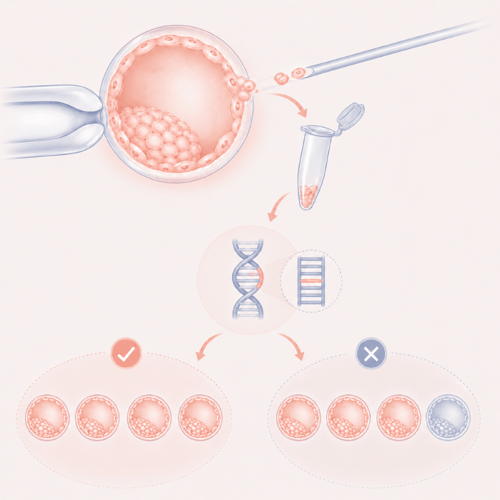
Eggs are retrieved, fertilized, and monitored in Illume’s laboratory. An embryologist carefully removes a small sample of cells from embryos that reach the blastocyst stage.
The biopsied embryos are frozen and stored at Illume. Cell samples are sent to the genetics lab, which analyzes the targeted variant and may also examine nearby DNA markers.
Your genetic counselor explains how each embryo was classified, what the results mean for you, and which embryos may be considered for transfer.
Exact terminology may vary by laboratory, but results generally fall into four categories.

The tested sample does not show the gene variant or combination of variants associated with the targeted condition. The embryo may still be a carrier in some situations.

The embryo has inherited the gene variant or combination of variants associated with the condition or disease predisposition being tested.

The embryo has inherited a variant associated with a recessive or X-linked condition but is not expected to be affected.

The lab could not confidently classify the sample. Poor DNA quality, contamination, or other factors may contribute. Rebiopsy may be an option in some cases.
A positive result does not always predict whether symptoms will develop, when they will begin, or how severe they will be. This is particularly important for conditions with reduced penetrance, variable expression, or adult-onset disease risk. Illume’s genetic counselors can explain the findings and help you understand how each result may affect your options.
Learn what PGT-M may help clarify and what it cannot determine.
Identifies whether the tested embryo sample inherited the specific familial gene variant or combination of variants.
May reduce the chance of passing the targeted inherited condition to a future child.
Helps patients prioritize embryos for transfer using condition-specific information.
Provides genetic information before embryo transfer rather than waiting until pregnancy for diagnostic testing.

PGT-M evaluates only the targeted gene and does not assess other genetic or health risks.
A negative result does not ensure implantation, pregnancy, live birth, or a healthy baby.
A variant may be detected without predicting severity, onset, or whether symptoms will occur.
Some cycles may not produce an embryo suitable for transfer and not expected to be affected by the targeted condition.

Important Considerations
PGT-M can be highly accurate for the specific familial variant it was designed to evaluate, but no embryo test is perfect. Because only a small sample of cells from the embryo’s outer layer is analyzed, false-positive, false-negative, or inconclusive results are possible. Contamination, poor DNA quality, or other factors may interfere with analysis, and custom test development may not be possible for every gene or variant.
Modern blastocyst biopsy removes a few cells from the embryo’s outer layer, called the trophectoderm. According to ASRM laboratory guidance, blastocyst biopsy has no apparent negative effect on cryopreservation or implantation potential when performed by skilled embryologists. Modern vitrification is also highly effective, although no individual embryo is guaranteed to survive warming.
If PGT-M produces an inconclusive result, rebiopsy may be considered. This requires another warming, biopsy, and freezing cycle. A systematic review and meta-analysis of PGT-A cycles found lower clinical pregnancy and live birth or ongoing pregnancy rates after double biopsy and double vitrification than after the standard single-biopsy, single-freeze process. Because the included studies were retrospective, the findings should be interpreted with caution.
Because diagnostic error is possible, ASRM recommends offering prenatal diagnostic testing during pregnancies conceived using PGT-M. Chorionic villus sampling or amniocentesis may be used to confirm the targeted result.
The proportion of embryos expected to be affected, unaffected, or carriers depends on how the condition is inherited. For an autosomal recessive condition in which both genetic parents are carriers, each embryo generally has:
For an autosomal dominant condition in which one genetic parent has one copy of the relevant variant, each embryo generally has a 50% chance of inheriting the variant.
For an X-linked condition, the chance of an embryo being affected or carrying the variant depends on which parent carries the variant, the specific condition, and the embryo’s sex chromosome pattern.
Each embryo represents an independent genetic event, so the results from a particular IVF cycle may not match these expected percentages. Age at egg retrieval, ovarian reserve, fertilization, blastocyst development, and any additional testing can further affect how many embryos are ultimately available for transfer.
These inheritance probabilities describe genetic risk. They don't predict how many eggs, blastocysts, or transferable embryos an individual IVF cycle will produce.

Schedule Your Consult Explore All PGT Options
Explore related information and read real patient stories.

Learn about PGT-M costs, custom test development, accuracy, and other considerations.
PGT-M costs vary widely because each case requires individualized laboratory review and custom test development. Expenses may include:
Total costs depend on the genetics laboratory, complexity of the test, number of embryos tested, and whether additional testing is performed. Insurance and fertility-benefit coverage also vary by plan. Your Illume financial coordinator can confirm current treatment, laboratory, biopsy, cryopreservation, and shipping costs.
Visit Illume’s Fertility Finance Hub for more information about insurance and financing.
Custom test (probe) development for PGT-M can take several weeks to several months, depending on the condition, variant, laboratory method, and availability of required DNA samples.
The external genetics laboratory must review and accept your case before creating and validating the family-specific test. Because development is not always successful, it should generally be completed before an IVF cycle begins.
PGT-M is technically possible for most inherited conditions with a known single-gene cause, but it cannot be developed for every gene or variant.
An external genetics laboratory must confirm that the familial variant can be detected reliably. Certain variants, repeat conditions, new variants without available family samples, and variants of uncertain significance may be more difficult or inappropriate to test.
PGT-M is not intended to assess complex conditions caused by multiple genes, environmental factors, or an unknown genetic cause.
Yes, PGT-M may be used for a confirmed disease-causing BRCA1 or BRCA2 variant. These variants increase the lifetime risk of certain cancers, but they do not guarantee that a person will develop cancer.
Testing for adult-onset disease predispositions involves personal and ethical considerations, including available screening, prevention, treatment, age of onset, and variable disease risk.
Consultation with an experienced genetic counselor is strongly recommended.
No. Genetic carrier screening tests DNA from an egg provider, sperm provider, or donor to identify inherited conditions they could potentially pass on.
PGT-M tests embryos created through IVF for a specific genetic risk that has already been identified. Carrier screening is one way a family may learn that PGT-M should be considered, but the tests answer different questions.
Not automatically. PGT-M evaluates a specific gene or inherited condition. PGT-A screens for extra or missing chromosomes.
The two tests can often be performed using the same embryo biopsy sample, but they are separate tests with different benefits, limitations, and costs. Adding PGT-A may also reduce the number of embryos considered for transfer and is not beneficial for every IVF patient.
It may be possible. Embryos that have not been biopsied may need to be thawed, biopsied, and frozen again. If an embryo was previously biopsied for PGT-A, the genetics laboratory may be able to use remaining amplified DNA, although this depends on the original laboratory method.
In some cases, a new biopsy is required. Your Care Team and the PGT laboratory will review the embryos’ history and explain the potential risks before recommending a plan.
A positive result does not automatically decide what will happen to an embryo. The next steps can depend on the result, the condition being tested, how many embryos are available, personal preferences, and clinic policies.
Possible options may include:
These choices can feel especially complex when results involve being a carrier, conditions that may appear later in life, or conditions that don’t always affect people in the same way.
Illume Fertility’s genetic counselors offer non-directive guidance and support to families so they can make informed decisions without pressure.
At Illume Fertility, our reproductive endocrinologists and in-house genetic counselors collaborate with external genetics laboratories to determine whether custom probe development for PGT-M is feasible.
Whether you are responding to carrier-screening results, a personal diagnosis, a known family condition, or a previous affected pregnancy or child, your Care Team will help you understand your options with clear, compassionate, and non-directive guidance.
Schedule Your Consult View IVF Success Rates