
Genetic carrier screening looks for inherited conditions that a parent or donor can pass to a child. Testing may be performed prior to pregnancy, during treatment planning, or when selecting a donor.
Illume Fertility’s in-house genetic counselors work closely with your physician to help you select an appropriate screening panel, understand your test results, compare partner or donor reports, and plan next steps if testing identifies a shared reproductive risk.

Schedule Your Consult Explore Genetic Counseling
Get a clear overview of genetic carrier screening and what results can tell you.

Carrier screening tests an egg or sperm provider. The person carrying a pregnancy is tested only if they are contributing an egg.

This type of screening may be performed prior to pregnancy, during fertility treatment planning, or in early pregnancy.

Looks for selected gene variants in an egg or sperm provider. Carrier screening is different than embryo or prenatal testing.

Carrier screening does not diagnose most causes of infertility, test every genetic condition, or guarantee a future child's health.
Disclaimer: This information is for educational purposes only and does not replace medical care or genetic counseling.
Genetic carrier screening examines DNA from a person providing eggs or sperm. It looks for gene variants linked to inherited conditions such as cystic fibrosis, sickle cell disease, and spinal muscular atrophy.
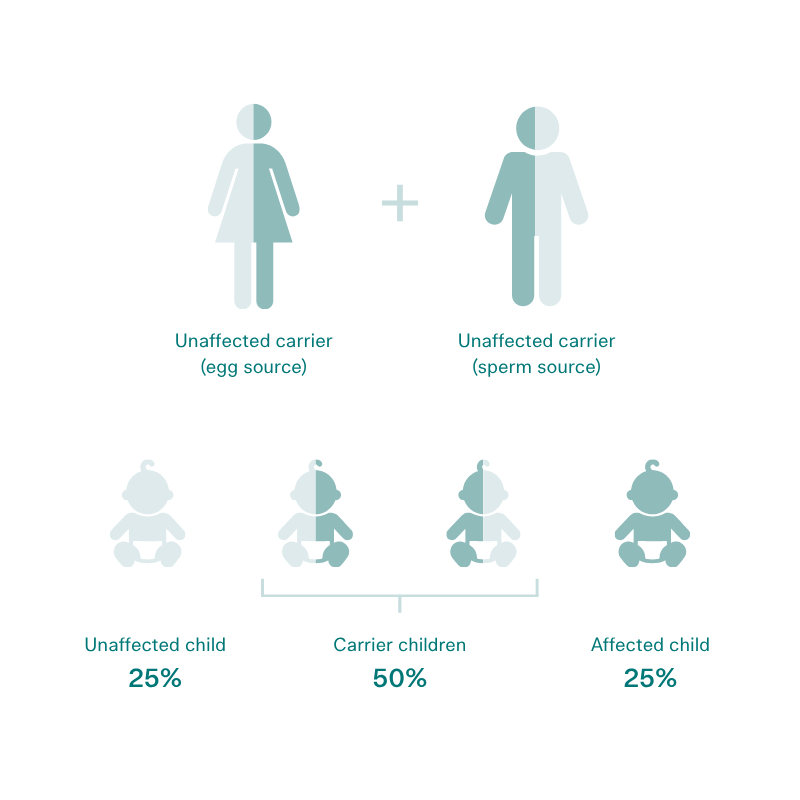
Most carriers of an autosomal recessive condition do not have related symptoms. Reproductive risk rises when both genetic contributors carry disease-causing variants in the same recessive gene. If both genetic contributors carry disease-causing variants in the same autosomal recessive gene, each pregnancy usually has:
X-linked conditions follow different inheritance patterns. Risk reflects the gene, the specific variant, and the sex chromosomes inherited by the pregnancy. Some X-linked carrier findings can affect the health of the person tested.
Carrier screening does not examine every gene, variant, chromosome difference, or health condition. A negative result lowers risk but cannot eliminate it.
Targeted and expanded genetic carrier screening differ mainly in how many conditions they test for and how family history, ancestry, and prior results guide test selection.
Screens for one condition or a small group selected from family history, prior results, or ancestry.
May include Tay-Sachs testing for people with Ashkenazi Jewish ancestry or screening for blood disorders that are more common in certain ancestry groups.
Helpful when a family member has a confirmed genetic change that the laboratory can test for directly.
Does not check for many conditions beyond the specific family-history or ancestry-related risks selected.
Looks for many serious conditions that can be passed down when both genetic contributors carry a related gene change.
Uses one broad panel instead of choosing conditions based only on race, ethnicity, or reported ancestry.
Can identify carrier status even with mixed ancestry, limited family health information, or no known genetic history.
May find rare or unexpected carrier results. Panels vary by laboratory, so a genetic counselor can help explain what the results mean.
Carrier screening is an option for anyone planning for pregnancy or fertility treatment. You do not need a history of infertility, a known genetic condition, or a family history of one to ask about testing. Screening may be helpful if:
Recessive conditions can be unknowingly passed down through generations. Many people carry at least one recessive condition without any symptoms.

Carrier screening can take place before or during fertility treatment or in early pregnancy. Here's what you can expect at each step.

Laboratory terminology varies, but carrier screening results often fit one of these patterns.

No reportable variant was found in the genes and variant types covered by the panel. The chance of being a carrier is lower, but residual risk remains.

A reportable variant was found in one copy of a gene. Most carriers of recessive conditions have no symptoms, though some findings may affect personal health.

Both genetic contributors have findings that create a higher chance of the same condition in a child. The exact risk follows the inheritance pattern.

The report requires partner testing, donor comparison, family records, targeted testing, or specialist review before reproductive risk can be estimated.
For most autosomal recessive conditions, a carrier result does not mean the person has the condition. Some carrier findings can affect personal health, so each positive result needs individual review. The inheritance pattern and findings from both genetic contributors shape the reproductive risk.
These test results may also offer important information for other biological relatives. Your genetic counselor can help explain who else in your family may benefit from testing.
Schedule Your Consult Explore Genetic CounselingA positive carrier result often leads to follow-up testing of the other person (your partner or donor) providing eggs or sperm. That test should cover the same gene and relevant variant types.
If the other genetic contributor tests negative, the chance of an affected child is often much lower. Residual risk remains since no screening test detects every disease-causing variant.
If both carry disease-causing variants in the same autosomal recessive gene, each pregnancy usually has a 25% chance of being affected. X-linked conditions and other inheritance patterns require a different risk calculation. The two laboratory reports must be reviewed together.

To discuss with your team

Depending on the finding, you may have several paths to consider. The right option depends on the condition, inheritance pattern, your treatment goals, timing, and personal preferences. Options may include:
These are personal decisions that only you and your family can make. Illume Fertility's in-house genetic counselors will explain the medical facts, answer your questions, and provide non-directive guidance to help you determine the best path forward.
For additional support navigating the emotional aspects of this journey, Illume's Integrated Fertility & Wellness program offers all patients access to a vetted network of licensed mental health professionals, onsite acupuncture treatment, and free, expert-led support groups.
When carrier screening leads to PGT-M
When carrier screening identifies a genetic variant, your physician or genetic counselor may recommend considering preimplantation genetic testing for monogenic conditions, or PGT-M.
PGT-M tests a small sample of cells from embryos created through IVF for a specific inherited condition. The familial variant must first be identified, then a PGT laboratory will review your case and create a testing plan.
However, a positive result from carrier screening does not mean that IVF treatment or embryo testing is automatically required. If only one genetic contributor carries an autosomal recessive condition and the other has a negative result, PGT-M is not recommended for carrier status alone in most cases. Your genetic counselor can explain residual risk, test limits, and any condition-specific exceptions.
Egg and sperm donors commonly complete carrier screening, but donor agencies, sperm banks, and laboratories don't all evaluate the same genes or variant types.
Two reports both marked "negative" may cover very different conditions. If the other genetic contributor is a carrier, both genetic contributors should be evaluated for the same conditions.
At Illume, our genetic counselors:

At Illume Fertility, you'll never have to work through the genetic testing process alone.

Work one-on-one with a licensed genetic counselor who takes time to understand your questions, values, preferences, and goals.

Get clear, understandable answers about your reproductive options without pressure, judgment, or direction toward one specific path.

Reconnect with your genetic counselor when new questions, test results, or family-building decisions arise during your journey.
Coverage for genetic testing varies by insurance plan, laboratory, diagnosis, and medical history. Some plans cover testing in full. Others apply a deductible, coinsurance, or exclusion.
Ask the genetics laboratory for an estimated patient cost before testing. Some laboratories offer self-pay rates or financial assistance.
If your results lead you to IVF or PGT, the associated treatment and laboratory charges are usually separate. Illume’s Finance Hub helps explain fertility benefits, cost estimates, and questions to ask your insurer.
Genetic carrier screening is usually optional and not required for fertility treatment.
For gestational surrogacy arrangements, ASRM recommends appropriate genetic evaluation for each person contributing eggs or sperm, including the people whose eggs and sperm created a donated embryo. The gestational surrogate does not contribute genetic material and does not usually need carrier screening for that pregnancy. She completes a separate medical screening process.
Carrier screening can be performed before conception, during fertility treatment planning, or early in pregnancy. Earlier testing gives you more time to review results, test the other genetic contributor if needed, and consider your reproductive options.
You do not need a known family history or infertility to consider screening. Many carriers have no symptoms or affected relatives. Screening estimates whether you carry variants for certain inherited conditions. It does not assess overall fertility or detect every genetic condition.
Carrier screening can identify a reproductive risk that leads to a larger discussion about PGT-M or prenatal testing. A positive carrier-screening result does not mean that IVF or embryo testing is automatically required.
A carrier result means the laboratory found a reportable variant associated with an inherited condition. For most autosomal recessive conditions, being a carrier does not mean you have the condition. It does not determine whether a future child will inherit the variant or develop the condition.
For autosomal recessive conditions, reproductive risk depends mainly on the other genetic contributor’s result. X-linked findings follow different inheritance patterns. Some carrier findings can affect the health of the person tested, so each positive result deserves careful review.
At Illume Fertility, your genetic counselor will review your full medical history, family history, donor information (if applicable), any prior pregnancies, and relevant lab reports.
You will discuss the benefits and limitations of genetic carrier screening or preimplantation genetic testing (PGT), reproductive risks, partner or donor testing, and possible next steps.
Illume's in-house genetic counselors offer non-directive guidance, providing you with clear medical information without pressure or judgment.
Meet our genetic counseling team:
If both the egg and sperm provider carry disease-causing variants in the same autosomal recessive gene, each pregnancy usually has a 25% chance of being affected. Each pregnancy has a 50% chance of producing an unaffected carrier.
Risks differ for X-linked conditions and other inheritance patterns. Your genetic counselor can explain the condition, expected severity, test limits, and reproductive choices.
Options may include conception without embryo testing, prenatal diagnosis, donor conception, or IVF with PGT-M.
A negative result means the laboratory did not find a reportable variant within the test’s scope. This lowers your chance of being a carrier for the conditions tested.
It does not reduce the chance to zero. The panel may exclude some genes, and its methods may not detect every disease-causing variant. This remaining chance is called residual risk.
ACOG explains the limits of negative carrier screening results.
Carrier screening cannot diagnose most causes of infertility.
A diagnostic evaluation, often called fertility testing, uses separate tests to assess ovarian reserve, ovulation patterns, the uterus and fallopian tubes, sperm quality, and other health factors.
Some genetic findings can affect fertility or pregnancy. Targeted testing can help when family history, pregnancy tissue testing, or recurrent loss raises a defined concern. A genetic counselor can explain which testing applies to your situation.
See our fertility testing overview and ASRM's recurrent pregnancy loss guidance for more information.
Egg and sperm donors commonly complete carrier screening, but requirements and panels vary across agencies, banks, and laboratories. Two reports marked “negative” may not cover the same genes or variant types.
If the other genetic contributor is a carrier, your genetic counselor should compare the full reports. This review confirms whether the donor received suitable testing for the same condition.
Learn more about donor conception at Illume.
Genetic screening is a powerful tool that can help clarify selected inherited risks and support decisions about further testing, fertility treatment, donor selection, or pregnancy planning.
Illume Fertility's in-house genetic counselors work closely with your reproductive endocrinologist to develop the right testing plan, understand your results, and find the best path forward.
Schedule Your Consult Explore Genetic Counseling