
PGT-A is an optional test that screens embryos created through IVF for extra or missing chromosomes. These chromosome differences can affect implantation, miscarriage risk, or a future child’s health.
Results provide additional information that may be considered alongside embryo development and grading when planning which embryo to transfer, although PGT-A is not beneficial for every IVF patient.
Schedule Your Consult Explore All PGT TypesGet a clear overview of what PGT-A examines and what its results can tell you.

Screens embryo samples for extra or missing chromosomes, a finding known as aneuploidy.

Can be performed on eligible embryos created through IVF prior to frozen embryo transfer, if desired.

Embryos may be reported as euploid, aneuploid, mosaic, or inconclusive depending on test results.

PGT-A does not screen for specific single-gene conditions and cannot guarantee pregnancy or a healthy baby.
Disclaimer: This information is for educational purposes only and is not a substitute for personalized medical counseling.
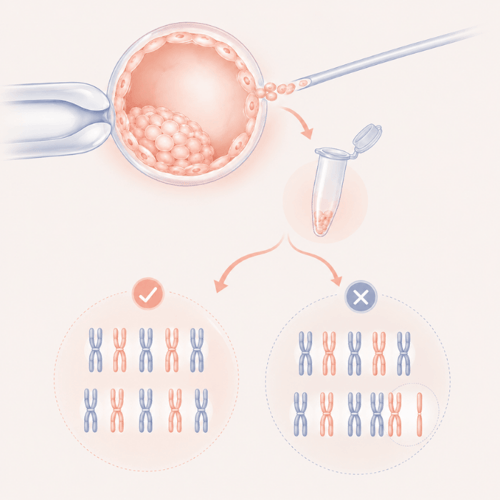
Preimplantation genetic testing for aneuploidy, or PGT-A, screens embryos for extra or missing chromosomes. Chromosomes are packages of DNA that carry our genes. Most human cells have 46 chromosomes arranged in 23 pairs.
An embryo with the expected number of chromosomes is described as euploid. An embryo with an extra or missing chromosome is described as aneuploid. These differences can prevent implantation, result in miscarriage, or cause certain chromosome conditions.
PGT-A can only be performed on embryos created through in vitro fertilization. It does not change an embryo’s DNA.
Results provide additional information that may be considered alongside embryo development and embryo grading when deciding which embryo to transfer.
PGT-A is not necessary or beneficial for every IVF patient. Your doctor may discuss it with you based on factors such as:
The chance of embryo aneuploidy generally increases as eggs age. However, age alone does not determine whether PGT-A will add value. Ovarian reserve, expected embryo number, treatment goals, cost and the possibility of uncertain results should also be considered.
The American Society for Reproductive Medicine states that the value of routinely using PGT-A for every IVF patient has not been demonstrated.

When PGT-A is included in an IVF cycle, embryos are biopsied at the blastocyst stage and remain frozen while a genetics laboratory analyzes the cell samples. Your Care Team will review the results with you and discuss transfer planning.

Eggs are retrieved, fertilized, and monitored in Illume’s laboratory. Embryos that reach the blastocyst stage may be considered for biopsy.
An embryologist carefully removes a small sample of cells from the trophectoderm, the outer layer that later contributes to the placenta.
Each biopsied embryo is rapidly frozen using vitrification, then stored at Illume while its cell sample is sent to a specialized genetics laboratory.
The genetics laboratory copies and analyzes DNA from the sample of biopsied cells to look for extra or missing chromosome material.
Results usually arrive within three weeks. Your genetic counselor explains the report and discusses how each result may affect transfer planning.
Exact terminology may vary by laboratory, but results generally fall into four categories.

The tested sample shows the expected number of chromosome copies (46 chromosomes arranged in 23 pairs).

The sample shows extra or missing chromosome material. The report identifies which chromosome difference was detected.

The sample produces an intermediate result that may reflect more than one chromosome pattern. Mosaic results require individualized interpretation.

The lab couldn't produce a clear result, often because the sample contained too little usable DNA. Rebiopsy may be an option in some cases.
Because PGT-A tests only a small sample from the embryo’s outer layer, the result may not represent every cell. If your report includes a mosaic or inconclusive result, Illume’s genetic counselors can explain how the laboratory classified it and what options may be considered.
Learn what PGT-A may help clarify and what it cannot determine.
Identifies embryos whose tested cells have the expected number of chromosomes.
Provides valuable genetic information that can help patients prioritize which embryo to transfer first.
May improve the chance of successful embryo implantation per transfer for some patients.
May lower the risk of chromosome-related miscarriage for some patients.
PGT-A may help prioritize embryos for single embryo transfer. Transferring one embryo reduces the risk of multiple pregnancy.

A euploid result cannot guarantee implantation, pregnancy, or a healthy baby.
It cannot determine whether an embryo will continue developing after transfer.
Testing does not change or improve an embryo’s underlying genetic potential.
Cannot predict with certainty whether an individual embryo will result in a live birth.
PGT-A does not improve outcomes for every IVF patient. Research findings vary depending on the patients studied and whether success is measured per embryo transfer, per retrieval cycle, or across all embryos created.
Selecting a euploid embryo may improve the chance of implantation for that individual transfer. However, testing does not create more embryos or improve their underlying potential. PGT-A may also leave some patients with fewer embryos available for transfer.
Randomized trials found similar overall pregnancy outcomes between PGT-A and conventional IVF in several patient groups. The value of PGT-A for reducing miscarriage or shortening time to live birth depends on individual circumstances and remains an active area of research.
The most useful question is not simply whether PGT-A works, but whether the information it provides is likely to add value to your specific IVF plan.

While PGT-A can reliably identify many chromosome differences, no embryo screening test is perfect. Here's why:
Some embryos reported as mosaic have resulted in healthy births. The American Society for Reproductive Medicine (ASRM) recommends careful genetic counseling because the meaning and reproductive potential of these results can vary.
PGT-A cannot replace prenatal care. All patients who become pregnant via IVF should be offered prenatal screening and diagnostic testing regardless of whether PGT was performed.
Disclaimer: PGT-A provides information about the cells tested and cannot identify every genetic or health condition, guarantee pregnancy, or replace recommended prenatal testing. Your Care Team can explain how these limitations apply to you.

Schedule Your Consult Explore All PGT Options
Explore related topics and common questions.

Learn more about PGT-A, from costs to ethical considerations and other factors.
PGT-A costs vary based on the genetics laboratory, number of embryos tested, and services included, but typically range from $350 to $500 per embryo. Insurance and fertility-benefit coverage also vary by plan. Your Illume financial coordinator can confirm current testing, biopsy, cryopreservation, and shipping costs.
Explore our Fertility Finance Hub for more information on insurance and financing options.
PGT-A may reduce the chance of transferring an aneuploid embryo, and aneuploidy is a common cause of miscarriage. However, not every miscarriage is caused by chromosome number, and studies have not shown that PGT-A provides the same benefit for every patient group.
Patients experiencing repeated losses should receive an appropriate recurrent pregnancy loss evaluation rather than assuming PGT-A will address every possible cause.
PGT-A can screen embryos for an extra copy of chromosome 21 (trisomy 21), which is the most common chromosomal cause of Down syndrome. It can also detect other whole-chromosome abnormalities, such as missing or extra copies of other chromosomes (aneuploidy).
However, PGT-A is a screening test of only a small sample of cells, not a diagnostic test of the entire embryo or resulting pregnancy. Because of this limitation, it cannot fully rule out Down syndrome or other chromosomal conditions.
If pregnancy occurs, prenatal screening and diagnostic testing options should still be offered. CVS or amniocentesis can provide diagnostic information about fetal chromosome status.
No. PGT-A evaluates chromosome copy number and cannot predict autism. Autism has complex, multifactorial causes and cannot be assessed through this type of embryo screening. PGT-A also cannot predict:
It is important to understand PGT-A as a chromosome screening tool, not a predictor of neurodevelopment or overall health outcomes.
Ethical considerations may include how results influence decisions about which embryos to transfer or continue storing, how uncertain or mosaic findings are interpreted, whether patients want to receive information about chromosomal sex, and how cost affects access to testing.
Because PGT-A analyzes only a small sample of cells from the embryo’s outer layer, the result may not represent every cell. Some embryos with mosaic results have resulted in healthy births. Deciding how to use an uncertain result is a personal decision that should include individualized guidance from your physician and genetic counselor.
PGT-A may also reveal an embryo’s sex chromosome pattern. Before testing, patients can discuss whether they want this information disclosed and how it may be used in transfer planning.
Cost and insurance coverage may also affect whether testing is accessible. Because the value of routine PGT-A for every IVF patient has not been demonstrated, it is important to discuss whether the information is likely to add value to your individual treatment plan.
PGT-A can identify an embryo’s sex chromosome pattern, typically reported as XX (female) or XY (male). This is sometimes referred to as "gender," but biologically it reflects chromosomal sex, not gender identity.
Key considerations:
A mosaic embryo may be considered for transfer after detailed counseling. These embryos generally have lower implantation rates and higher miscarriage rates than euploid embryos, but healthy births have occurred.
What makes sense for you depends on the chromosome involved, the type of finding, your lab's reporting thresholds, how many embryos you have, and your own preferences, which is why ASRM recommends individualized counseling rather than a blanket rule.
At Illume Fertility, our team of licensed genetic counselors provides non-directive guidance and education to help each patient make the best decision for their family.
At Illume, the guidance you receive is grounded in your circumstances, not a one-size-fits-all recommendation. Your reproductive endocrinologist considers your age, ovarian reserve, treatment history, and family-building goals before discussing whether testing like PGT-A may add value.
Our embryology team and in-house genetic counselors work alongside your physician to help you understand both the potential benefits and realistic limitations of testing.
Schedule Your Consult View IVF Success Rates