
September 15th, 2024 | 14 min. read

Embryo grading is a critical aspect of the in vitro fertilization (IVF) process that can provide valuable insights - but it's not the only indicator of an embryo's potential. In this guide, we will explore how embryo grading works and what it can (and can't) reveal about an embryo.
In this article:
- What is embryo grading?
- How are Day 3 embryos graded?
- Is embryo grading beneficial?
- What is the best embryo grade?
- Is 4AA or 5AA better?
- Success Rates by Embryo Grade
- Can lower-graded embryos still result in pregnancy?
- Embryo Grading Systems
- Embryo Grading vs. PGT
- Does embryo grading matter if I'm doing PGT?
- Aneuploid, Euploid & Mosaic Embryo Types
- Can mosaic embryos still be successful?
- Mosaicism vs. Aneuploidy
- Can you tell gender by embryo grading?
- Are you more likely to have a girl or boy with IVF?
- Can embryos with "good" grades still have chromosomal issues?
- Why did my "perfectly-graded" embryo fail to implant?
- Day 3 vs. Day 5 Embryo Transfer
- Can embryo grade change after thawing?
- An Embryo's Grade Isn't All That Matters
What is embryo grading?
Embryo grading is a tool that embryologists use to assess embryo quality and track their development in the IVF lab for 3-7 days. Grading helps assist the lab in determining which embryos are suitable for transfer and which can be cryopreserved (frozen and stored) for future family building.
However, an embryo's grade isn't the only thing that matters. As you explore the world of embryo grading, keep in mind that your medical team will take a whole host of other factors into account before choosing which embryo to transfer, including:
- Your age
- Your fertility history
- How many embryos are being transferred
- Which day of embryo development gives you the best chance of success
Note: The highest quality embryos tend to develop between Day 5 and Day 7 of culture.
When do you find out embryo grading?
Initial embryo grading is typically performed on Day 3 and Day 5 after egg retrieval, once the eggs have fertilized. The final embryo grade is usually received when the embryo reaches the blastocyst stage, which can be on Days 5, 6, or 7 of culture.
Embryo culture is a process that involves growing embryos in a laboratory setting to help with assisted reproduction procedures and in vitro fertilization (IVF).
All suitable blastocysts are graded and cryopreserved (frozen) within seven days after your egg retrieval or before a scheduled embryo transfer. You can discuss grades with your physician during this timeframe, or ask your Care Team whenever you have questions.
How are Day 3 embryos graded?
While Day 5 to 7 embryos are graded using the Gardner system (more on this below), Day 3 embryos are assessed by the quantity and quality of cells and degree of fragmentation (e.g. how much cells have broken off during division) after fertilization.
By Day 3 of culture, embryos composed of 6-8 cells are more likely to develop to the blastocyst stage than embryos with less than 6 cells. Fragmentation is a normal phenomenon, and some fertility clinics record the percentage of fragmentation, while others do not.
How much fragmentation is acceptable in an embryo?
Generally, embryos with more than 25% fragmentation are considered to have low implantation potential, whereas embryos with less than 25% fragmentation are considered to have a higher implantation potential.
Is embryo grading beneficial?
In short, yes! A 2023 study published in the US National Library of Medicine revealed that embryos with a higher grade had better clinical pregnancy and live birth rates when compared to embryos with a lower grade.
Keep in mind that factors such as the genetic makeup of the embryo, the conditions of your clinic's laboratory, and the experience level of its embryologists also influence your overall chances of success with IVF.
“Embryologists will often use an embryo's grade to help predict which embryos are "hearty" enough to undergo processes such as biopsy (for preimplantation genetic testing, or PGT), cryopreservation (freezing), and thawing.”
The bottom line: Genetics (which can only be evaluated through PGT) are the most important piece of the puzzle, but embryo grading still plays a key role.
What is the best embryo grade?
Before we break down embryo grading further, it's important to understand the structures we'll be referring to. An embryo consists of three distinct parts:
- The shell (zona pellucida)
- The inner cell mass (ICM), which develops into the fetus
- The trophectoderm, which develops into the placenta
Any embryo with an expansion number of 3 and above with an ICM and trophectoderm grade of A, B, or C would be considered high quality. Our data shows that these embryos have potential for implantation, and therefore meet the criteria for cryopreservation and biopsy (if applicable).
Remember: Even if your embryo(s) received a grade that falls within the "low quality" range, it doesn't necessarily mean that it can't (or won't) lead to a healthy baby. Always ask your Care Team for information or reassurance whenever you have questions.
Is 4AA or 5AA better?
There is a correlation between embryo grade and successful pregnancy rate. Overall, embryos with an A-grade ICM or trophectoderm have higher pregnancy and live birth rates. The only difference between a 4AA and a 5AA is the degree of expansion.
- If we were to look at them both under a microscope, the only difference we would see is that the 4AA embryo is still in its shell, whereas the 5AA is showing signs of hatching (in non-PGT cases).
- In PGT cases, a 4AA and 5AA are both considered "hatching" blastocysts, with the latter simply being more expanded. Regardless of testing status, know that these are both high-quality embryos.
Even if you have a C-grade embryo, don't worry, this is still considered good quality, and can result in a successful pregnancy and a perfectly healthy baby!
Success Rates by Embryo Grade
Research has shown that expanded embryos are twice as likely to result in a clinical pregnancy as opposed to early blastocysts.
However, that does not mean that embryos of a lower grade are not usable for transfer. There are many other factors that can impact an embryo's successful implantation, from genetics to the uterine environment.
IVF Success Rates
Dr. Ilana Ressler explains your chances of success with IUI and IVF at Illume Fertility and what factors can impact your results.

Can lower-graded embryos still result in pregnancy?
Because embryos are constantly dividing and reorganizing, even a lower-graded embryo may end up receiving a higher grade the following day (after extended culture). It is important to remember that a single grade does not necessarily determine the embryo’s fate.
Most importantly, lower grade embryos can (and do) still make beautiful and healthy babies!
Embryo Grading Systems
At Illume Fertility, we follow the Gardner embryo grading system, which was developed by Dr. David Gardner in the late 1990s. Although many fertility clinics utilize the Gardner grading system, some do not - it simply depends on each clinic and lab team's preferences.
This system is used to evaluate embryos by assigning three separate quality scores, which are based on the following factors:
- Degree of expansion
- Compaction of the inner cell mass (ICM)
- Symmetry of the trophectoderm (TE)
These three characteristics are evaluated and assigned an alphanumeric score to help tell embryos apart. Essentially, embryologists will look at the morphology (appearance) of these structures under a microscope and assign them a grade that reflects what they see.
What is the degree of expansion?
The degree of expansion is assigned a number between one and six and refers to the size of the blastocyst cavity. This cavity develops on Day 5 or Day 6 of embryo culture (i.e. 5-6 days after fertilization) and is clearly visible at this point in time.
Expansion is graded based on whether the volume of the cavity occupies less than half, half, or more than half of the entire space of the embryo. As the embryo grows, the size of the blastocyst cavity increases and the zona pellucida (ZP), which is the shell of the embryo, begins to thin, allowing the embryo to further expand, hatch, and implant in the uterine wall.
The degrees of expansion for a developing blastocyst are as follows:
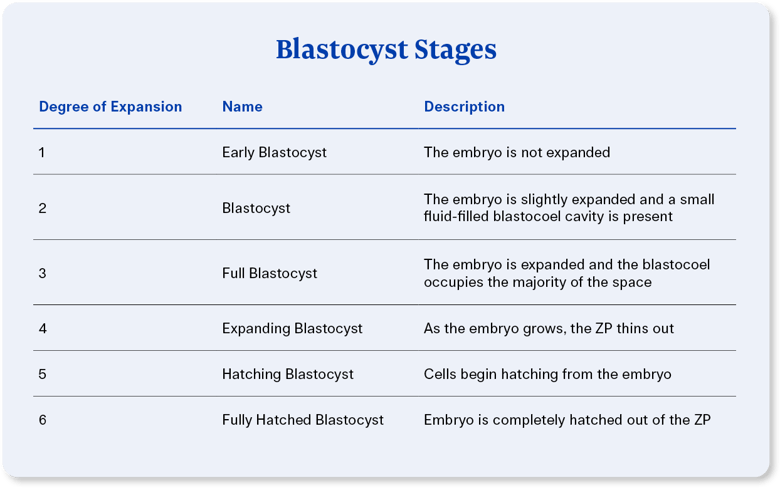
Note: The above table shows how embryos that have not been tested are graded. Embryos that have undergone preimplantation genetic testing (PGT) are considered to be "hatching blastocysts" with an expansion of 3 and above.
What is the inner cell mass (ICM)?
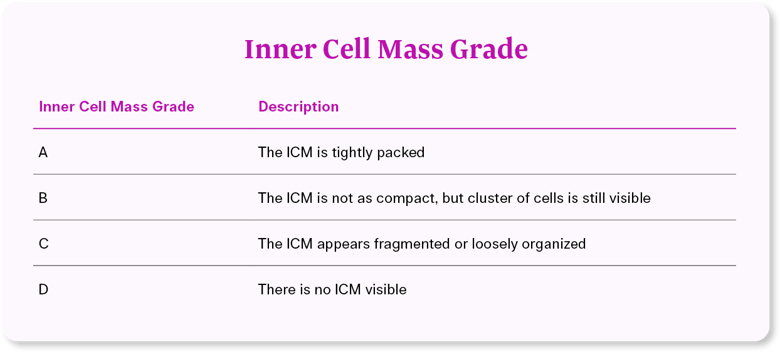
The inner cell mass (ICM) refers to a group of cells in an early embryo that will eventually develop into the fetus. The ICM is surrounded by a single layer of trophoblast cells, which give rise to the placenta.
Research has shown that the morphology (appearance) of the ICM can be a strong predictor of live birth after a frozen-thawed single embryo transfer. Here's what each ICM grade means:
What is the trophectoderm (TE)?
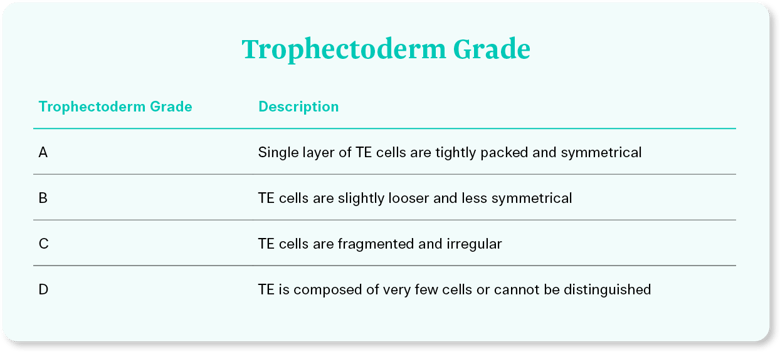
The trophectoderm epithelium (TE) is the outer epithelial (tissue) layer of the blastocyst. It differentiates into trophoblast cells, which then form the placenta and other types of membranes. The TE is responsible for specific functions, including:
- Helping the embryo "hatch" - the process by which an embryo breaks out of the zona pellucida to implant in the uterus. This occurs between Days 5 and 7 of development.
- Helping the embryo attach to the uterine wall.
The inner cell mass and trophectoderm are both assigned a letter grade based on the organization of the cells. The more organized cells are assigned a letter grade of A, whereas intermediate or less organized cells are assigned a letter grade of B or C, respectively.
Embryo Grading vs. PGT
The main difference between embryo grading and preimplantation genetic testing (PGT) is that embryo grading assesses the embryo's appearance, while PGT assesses the embryo's chromosomal arrangement. More specifically:
- Embryo grading is a non-invasive method of assessing an embryo's development at the morphological (physical) level, and usually occurs inside a fertility clinic's embryology lab.
- Preimplantation genetic testing (PGT) is used to understand the genetic makeup of an embryo. When an embryo is biopsied, a small sample of cells is taken from it by an embryologist at your fertility clinic, then sent to an outside laboratory for comprehensive genetic testing.
The Benefits of PGT
PGT is a powerful tool that helps to identify whether an embryo is euploid (has the normal number of chromosomes), aneuploid (has an abnormal number of chromosomes), or mosaic (a combination of normal/abnormal). It can also detect chromosomal abnormalities that are passed down from one generation to the next.
This form of testing is currently the only way to determine an embryo's sex, that is, whether an embryo carries two X chromosomes (making it biologically female) or an X and a Y chromosome (making it biologically male).
In short, PGT allows the fertility doctors, genetic counselors, and embryologists on your Care Team to help you make the most informed decision during your IVF journey.
Does embryo grading matter if I'm doing PGT?
Embryo grading, with or without PGT, is still important! The addition of PGT during an IVF cycle simply provides an extra layer of information to you and your doctor, as it helps identify embryos that are chromosomally abnormal - before an embryo transfer is performed.
The lab cannot differentiate between a euploid or aneuploid embryo based on its grade alone. That said, if you choose not to utilize preimplantation genetic testing (PGT), you will still receive the same treatment as individuals or couples who do.
Note: Genetic testing of embryos is not legal in every country.
IVF Treatment 101
Learn everything you need to know about in vitro fertilization (IVF) with our free Step-by-Step Guide to IVF Treatment!

Aneuploid, Euploid & Mosaic Embryo Types
If you do choose to have preimplantation genetic testing (PGT) performed on your embryos, the results will come back to your fertility clinic's lab with a detailed analysis of each embryo that was biopsied.
Depending on the type of testing, you and your doctor may also receive additional information regarding the sex of the embryo, as well as any chromosomal abnormalities or genetic anomalies. In this report, each embryo will typically be labeled as euploid, aneuploid, mosaic, or inconclusive.
Let's discuss what each of these terms mean.
What is a euploid embryo?
Euploid embryos are considered to be genetically "normal" because they contain the correct number of chromosomes (46). These embryos are more likely to implant and lead to a successful pregnancy, and have a lower risk of miscarriage. They are also less likely to result in a baby with physical or intellectual challenges due to chromosomal abnormalities.
A euploid result lowers chromosome-related risk, but it cannot predict every outcome. New research has examined whether weight increases the risk of pregnancy loss after euploid embryo transfer.
The percentage of euploid embryos your body makes naturally decreases as you age.
However, if you choose to freeze your eggs at age 30, those eggs will always remain as "old" as they were at the time of your egg retrieval. This means that if you thaw those eggs and use them to create embryos at age 38, they will still have the same chances of success as they would have at age 30.
Note: Preimplantation genetic testing for aneuploidy (PGT-A) is the specific form of PGT that can be used to determine an embryo's chromosomal arrangement.
What is an aneuploid embryo?
An aneuploid embryo has an abnormal amount of chromosomes (either too many or too few) which can lead to developmental issues in the growing fetus. This can lead to a number of adverse outcomes, including:
- Failed implantation
- Miscarriage
- Developmental issues
- Genetic disorders
- Physical or intellectual challenges
Did you know? In humans, a normal embryo has 46 chromosomes, with 23 pairs. The first 22 pairs are called autosomes, and the 23rd pair are the sex chromosomes.
What is a mosaic embryo?
Mosaic embryos are a little more complicated, because they contain both normal and abnormal cells. This occurs when there is inadequate separation of the chromosomes during cell division.
While chromosomal abnormalities like Down’s syndrome are a result of abnormal egg or sperm development (and therefore present prior to fertilization), mosaicism occurs after the sperm fertilizes the egg. Mosaicism does not increase with the parents’ ages and occurs equally across all age groups.
Geneticists classify embryos using the following criteria:
- Normal – fewer than 20 percent of the embryo's cells are abnormal
- Abnormal – greater than 80 percent of the cells are abnormal
- Low-level mosaic – 20 to 40 percent of the cells are abnormal
- High-level mosaic – 40 to 80 percent of the cells are abnormal
Can mosaic embryos still be successful?
While mosaic embryos can implant and result in healthy live births, they do have lower clinical pregnancy and live birth rates and higher miscarriage rates than euploid embryos.
Mosaicism vs. Aneuploidy
The biggest difference between mosaicism and aneuploidy is the genetic makeup of an embryo's cells. Mosaicism refers to the presence of cells with varying genetic compositions within an embryo, while aneuploidy refers to an abnormal number of chromosomes in all or most of the cells.
Embryo Grading FAQs
We know that we've given you a lot of information to digest when it comes to embryo grading and PGT. Let's unpack a few follow-up questions we frequently get from IVF patients:
Can you tell gender by embryo grading?
No, an embryo's sex can only be determined through preimplantation genetic testing (PGT).
Are you more likely to have a girl or boy with IVF?
The theory that IVF skews the gender ratio isn’t at all surprising. It has been stated that more male embryos are produced than females because they have higher morphology, develop faster, and survive better in culture.
A similar pattern is seen in natural conception, and it is theorized that this is an evolutionary approach to compensate for lower male survivability overtime. However, this raises a lot of questions as to whether IVF contributes to skewing the gender ratio and how that affects the sustainability of our general population.
Can embryos with "good" grades still have chromosomal issues?
Ever heard the saying, "Don’t judge a book by its cover"? Well, the same concept applies to embryos! An embryo may look great from an embryologist's point of view and be assigned a "good" grade, but genetics might end up telling a different story.
Embryos can have good grades and still possess a chromosomally abnormal trait. If you have a hereditary genetic disorder and would like to test your embryos prior to transfer, please ask your Care Team about meeting with a genetic counselor.
Why did my "perfectly-graded" embryo fail to implant?
No embryo is perfect, but each one is unique. There are many different reasons as to why some embryos implant while others do not - regardless of their grade. We know this can be frustrating to hear.
The process of implantation is the ability of the embryo to communicate with the cells of the uterus. If you transferred a high-quality embryo and implantation was still unsuccessful, it may be the result of inadequate endometrial receptivity or how well the embryo and uterus communicate with each other.
How to increase your chances of success:
- Assess uterine environment: If you've had multiple unsuccessful transfer cycles, talk to your physician about an endometrial receptivity test (ERA) to determine your optimal implantation window prior to a scheduled transfer.
- Add embryo testing: If you haven’t done so already, you may also want to consider utilizing preimplantation genetic testing (PGT) to maximize your chances of transferring a high-quality embryo.
Day 3 vs. Day 5 Embryo Transfer
According to research from the American Society for Reproductive Medicine (ASRM), "Blastocyst stage and grade have an important role in predicting the likelihood of a clinical pregnancy, and can provide useful information when counseling patients around the time of embryo transfer."
An embryo transferred on the fifth day of development (as a blastocyst), is generally considered superior to a Day 3 embryo transfer due to higher pregnancy rates, better embryo selection, and a lower risk of multiple pregnancies, as the longer development time allows for a more thorough evaluation of the embryo's quality.
However, a Day 3 transfer may be suitable for patients with limited embryos or who want to minimize lab exposure time.
Can embryo grade change after thawing?
After an embryo is thawed, it will usually expand, as it is cultured in the dish prior to embryo transfer. The expansion or hatching status may change slightly if the embryo completely hatches out of its shell. For example, your embryo may go from a 4AA (where it is partially in its shell) to a 6AA (where it is completely out of its shell).
Is Day 3 or Day 5 better?
An IVF nurse explores the benefits of allowing embryos to develop to the blastocyst stage before transferring or freezing them.

An Embryo's Grade Isn't All That Matters
While embryo grading is a valuable tool in the IVF process, it is only one piece of the puzzle.
The grade of an embryo can provide important insights into its potential for successful implantation and development, but it is not the sole determinant of success. Factors such as genetic makeup, the uterine environment, and your overall health and fertility history also play crucial roles.
By understanding the nuances of embryo grading and working closely with your Care Team, you can make informed decisions that enhance your chances of achieving a successful pregnancy. Remember, each embryo is unique, and even those with lower grades can still lead to healthy, happy babies!
This article received additional medical review from Rose Marie Roth, MSc, TS (ABB).
Disclaimer: The information provided in this article is intended for educational purposes only and should not be construed as medical advice. Always consult your doctor to address any concerns.

Trying to conceive?
Take a short quiz and receive personalized recommendations on your best fertility treatment options.
