
April 18th, 2026 | 9 min. read

Secondary infertility is one of the most common fertility challenges no one talks about. If you conceived easily before and are now struggling to get pregnant again, you're not alone. In this story, Trisha and James share their experience navigating secondary infertility and finding success through IVF at Illume Fertility in Connecticut.
In this article:
Meet Trisha & James
Trisha and James never expected to end up at a fertility clinic. They met, fell in love, and got married in their early 30s. When they decided to start a family, Trisha got pregnant on the first try. Their son James arrived on April 30, 2022, healthy and perfect, and the couple happily settled into life as a family of three in Pawling, New York.
Parenthood suited them. They embraced their new roles and loved watching their son grow and change. When they felt it was time to give James a sibling, they assumed the road ahead would look a lot like the one they had already traveled.
But for months, it looked like a road that wasn't going anywhere.
Dreaming of Baby #2
Trisha and James started trying to conceive their second baby in the summer of 2023. A month passed, then several more. Trisha added ovulation test strips to her daily routine, tracked her cycles more carefully, and paid attention to timing in a way she had never needed to before.
But time kept marching on, and all of the pregnancy tests kept coming back negative. Eventually, she sought help from her OB/GYN, who prescribed Clomid to induce ovulation and improve the couple's chances. Still, nothing changed.
After more than a year with no success, Trisha and James were referred to Illume Fertility.
Searching for Answers
After the couple completed fertility testing, their official diagnosis was a frustrating one — idiopathic infertility, meaning no specific cause could be identified. In their case, it manifested as secondary infertility: the inability to conceive after previously having a biological child, a condition that affects roughly 1 in 10 couples.
Despite how common it is, secondary infertility occupies a strange and isolating emotional space. There isn't a visible, dedicated community for it, and the people around you often assume that because you already have one child, the heartbreak of not being able to have another must somehow be less painful.
For most couples navigating it, that couldn't be further from the truth. "We never thought we would have had an issue conceiving again," Trisha recalls. "At times, it felt so hopeless."

Photos: The couple on their wedding day (Greg Lewis Photo); at James's 2nd birthday party; James playing.
Starting IVF: What No One Tells You
After coming to Illume in the fall of 2024, Trisha and James began working with Dr. Joshua Hurwitz. What followed was a steep (and often surprising) education in what fertility treatment actually involves.
Before going through it herself, Trisha had only a vague sense of what IVF entailed. The day-to-day reality of being a fertility patient, she quickly discovered, was far more complex.
"I honestly just thought it would be a few injections and then an egg retrieval," she admits. "I didn't know about the extensive testing, the multiple vitamins and medications, the egg retrieval process, the embryo testing—I had no idea how much was actually involved."
What is IVF really like?
IVF requires close monitoring across an entire stimulation cycle, with regular blood work and ultrasounds to track how follicles are developing in response to medication. The egg retrieval procedure that follows is only one piece of a much longer process.
After eggs are collected, they are fertilized in your fertility clinic's lab, either by placing egg and sperm in a dish to "mingle" naturally or by using a technique called ICSI (intracytoplasmic sperm injection), in which a single sperm is injected directly into each mature egg.
The resulting embryos are then cultured for several days before they are able to be biopsied and sent for genetic testing.
This optional step, called preimplantation genetic testing for aneuploidy (PGT-A), can screen each embryo for chromosomal abnormalities before a transfer is attempted, helping to identify which embryos are most likely to result in a healthy pregnancy.
For Trisha and James, all of this was brand new territory.
New to IVF?
Like Trisha, most people are surprised by what the IVF process actually involves. Before your first appointment, it helps to know what you're walking into.

The Results They Weren't Expecting
After Trisha's first egg retrieval, the waiting began. Their resulting embryos were biopsied, sent off for PGT-A screening, and the report came back: zero viable embryos.
Hearing news like this is one of the hardest moments in IVF, and one that doesn't get talked about enough. Sometimes, even when stimulation medications work, the egg retrieval goes smoothly, and the lab does everything right, there is nothing left to transfer.
No embryos that passed testing. No clear next step to take on the other side. Just the need to sit with that confusing sense of loss, absorb it as fully as possible, and then make a decision about whether to try again.
For some couples, this is where the journey ends. The emotional, physical, and often, financial toll of a second IVF cycle, layered on top of everything that came before it, is more than some people can ask of themselves.
But Trisha and James made the decision to try again, determined to grow their family.
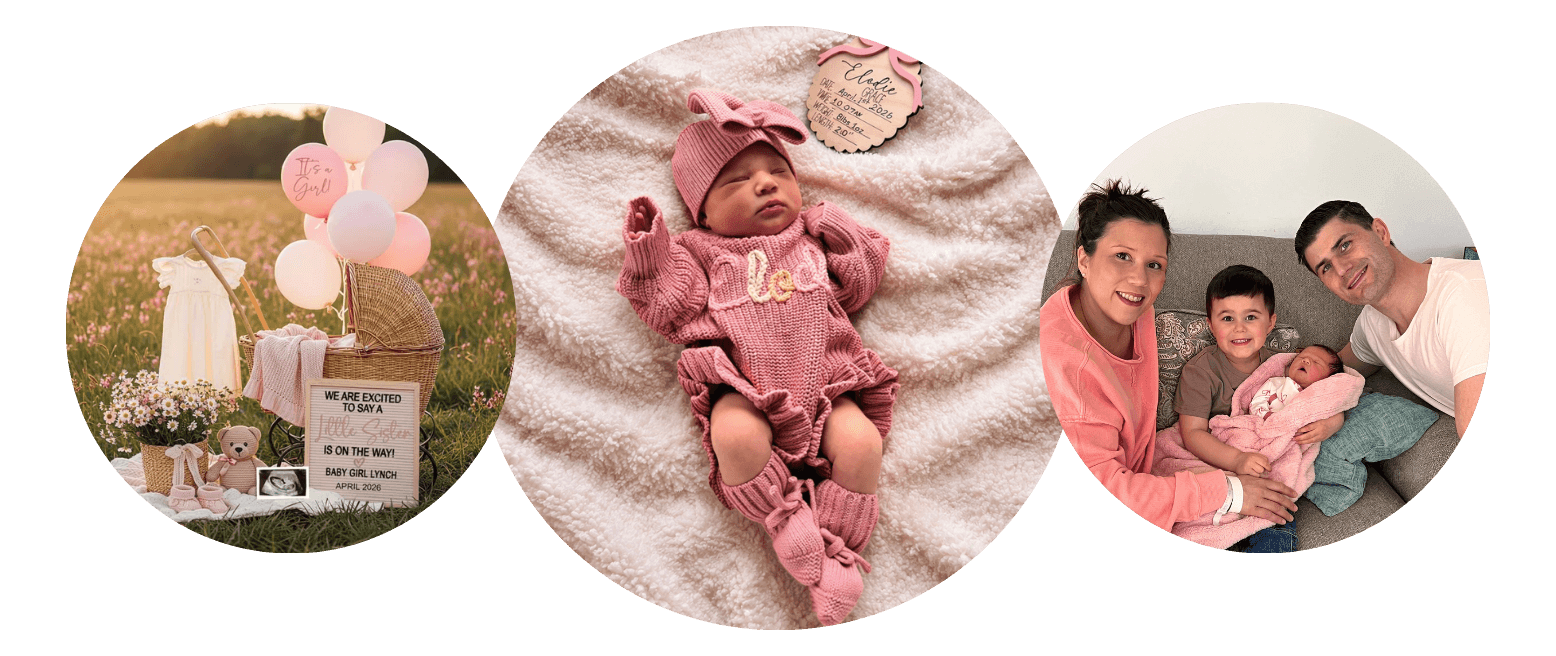 Photos: Pregnancy announcement; newborn Elodie; the new family of four together at home.
What Kept Them Moving Forward
Getting through that difficult period required a lot of support. At Illume, Trisha and James felt bolstered by the team around them. "The staff at Illume were a huge part of putting our fears at ease," she says.
She describes a team that didn't simply move them through a clinical checklist, but one that made them feel genuinely supported through the uncertainty. That distinction matters more than it might seem when a patient is trying to summon the resolve to keep going.
Trisha also leaned into the online IVF community that has grown across social media platforms in recent years. These spaces, built largely by patients for patients, have become an unexpected and important source of solidarity for those in treatment.
"Social media IVF support pages really helped," she says. "It felt like we were part of a huge family all going through the same thing." Knowing that others were in the same trenches, dealing with that familiar uncertainty and disappointment, made it a little easier to keep moving forward.
IVF Cycle #2
Trisha and James made it through their second IVF cycle, and this time, the outcome was different—but still not what they expected. After egg retrieval, fertilization, and PGT-A screening, they only had one embryo cleared for transfer.
"We had so many hopes and dreams riding on that one little embryo, it was hard not to feel anxious," Trisha says. "But I wish I could go back and tell myself not to worry so much, because only getting one viable embryo is not a failure."
The couple brought a fresh perspective into their second embryo transfer: not reckless optimism, but a grounded, deliberate choice to believe it could work. They had followed every step of their IVF protocol to the letter, trusted their care team, and done everything within their power.
Now there was nothing left to do but try to hold space for a good outcome without gripping expectations too tightly. Around ten days post-transfer, they were elated to get the news they'd been hoping for: their second transfer had been successful.
They were finally pregnant with Baby #2.
Becoming Parents (Again)
On April 1, 2026, Trisha and James welcomed their daughter, Elodie, into the world. Their family of three finally became a family of four, nearly three years after they first started trying.
Elodie's arrival didn't erase the difficulty of the road that led to her. It didn't make the disappointment of their first IVF cycle less painful or make the years of uncertainty any easier to look back on.
But it gave their journey more meaning, and gave Trisha something she now feels called to pass forward: an honest account of what this process actually looks like, from a patient's perspective.
"Before being in the IVF trenches, I really had no idea," Trisha says. "Now I know, and I try to be as open as I can about this process so others can be aware."
What is secondary infertility?
Struggling to conceive again after having a child is more common than most people realize. Here's what you should know about secondary infertility.

Why They Share Their Story
Secondary infertility sits in a complicated emotional space. You already have a child you love, which means the grief of not being able to have another often comes wrapped in guilt. You wonder if you're 'allowed' to feel this devastated.
The people around you, often with the best intentions, sometimes say things like "Well, at least you have one!" And somehow, that makes the whole experience even lonelier.
Trisha wants anyone currently in that position to know that what they're feeling is valid, that the desire to grow your family doesn't require justification, and that the journey through it, however long, is a well-worn path other people have walked before them.
Her advice is simple, but hard-earned: "This is a marathon, not a sprint. Keep going, even when it's hard. And don't be afraid to talk to other people who have gone through it."
The Gift of Perspective
"We're so grateful to Illume for helping make this dream a reality," Trisha says. "I really hope that sharing our story can inspire another family to explore IVF if they need it."
For Trisha, talking openly about her experience with infertility isn't just therapeutic. It's intentional. She knows that somewhere, another couple is sitting in the same uncertainty she and her husband once did, convinced they were the only ones struggling.
She wants them to know they're not. And if sharing that simple truth helps even one family keep going, Trisha says, then every hard step she and James took was worth it.
And if sharing that truth helps even one couple keep going, Trisha says, then every hard step was worth it.Because someone did that for her, and it made all the difference.

Free Fertility Assessment
Take a short quiz to receive personalized recommendations on your best fertility treatment options.
