
One couple's inspiring story of navigating loss, finding hope, beating the odds, and welcoming identical twin girls after IVF.
April 21st, 2026 | 12 min. read
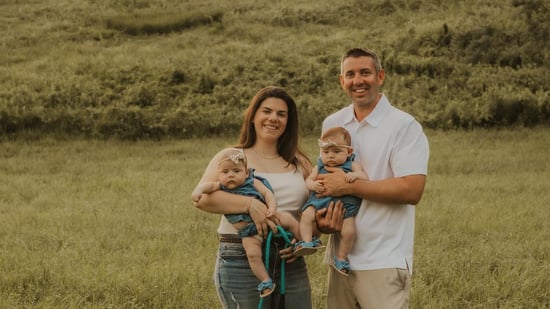
When Kaitlyn and Travis began their fertility journey, they never imagined it would lead to IVF, let alone that their entire chance at parenthood would rest on a single egg. What followed was a story of loss, faith, and a surprise that even their doctors didn't see coming.
In this article:
- Meet Kaitlyn & Travis
- A Year of Trying & Loss
- When High Numbers Aren't Good News
- The Decision to Move Forward with IVF
- What does IVF actually involve?
- One Egg, One Chance
- Understanding the IVF Funnel
- The Surprise of a Lifetime
- How does one embryo become identical twins?
- What Carried Them Through Infertility
- It Takes a Village to Build a Family
Meet Kaitlyn & Travis
Kaitlyn and Travis found each other in 2019 through Travis's brother and a mutual friend named Danielle. It didn't take long for Kaitlyn to recognize something special in him. "Travis is such a kind-hearted, hardworking, always sees the light at the end of the tunnel kind of guy," she says.
The couple dated for a few years before Travis proposed in December 2021. They were married in March 2023, and from the beginning, starting a family was always part of the plan. Kaitlyn had seen Travis interacting with their nieces and their friends' kids, and she already knew: he was going to be an incredible dad.
The two of them dreamed of raising a family on Candlewood Lake in New Milford, Connecticut, where they live, sharing their love of the water with their kids someday. Life felt full, and it was only getting fuller.
What they didn't expect was that infertility would soon define the next chapter of their story.
A Year of Trying & Loss
Kaitlyn and Travis began trying to conceive in March 2023. Six months later, in September, they were excited to see their first positive pregnancy test. Shortly after, the couple experienced a devastating loss.
Miscarriage is one of the most common (and least talked-about) experiences in early pregnancy, affecting roughly 1 in 4 known pregnancies. For many couples, it's the first time they realize that conception and pregnancy are far less guaranteed than they once assumed.
In Kaitlyn and Travis' case, it was a painful detour on a journey that was had already proven to be a lot harder than they expected. They kept trying. Month after month, nothing. After a full year of attempting to conceive without success, Kaitlyn went to her OB-GYN looking for answers.
When High Numbers Aren't Good News
When Good Numbers Aren't Good NewsBlood work soon revealed the source of their struggle: her FSH levels were extremely high, a sign of diminished ovarian reserve (DOR). While you might expect a higher FSH reading to be a good thing, in this context it actually signals the opposite. Here's why:
- Ovarian reserve refers to the quantity of eggs remaining in the ovaries. Follicle-stimulating hormone (FSH) is one of the key markers used to assess it.
- When the ovaries have fewer eggs to work with, the brain has to work harder to stimulate them, sending a stronger hormonal signal that results in elevated FSH levels.
- Combined with other markers like AMH and antral follicle count, high FSH and low AMH together can point to a reduced pool of eggs available for fertilization.
Getting a diagnosis like DOR can feel like the floor dropping out. For many women, it comes with a complex mix of grief, confusion, and urgency.
After receiving this unexpected test result, Kaitlyn and Travis were quickly referred to Illume Fertility and began working with Dr. Alexander Kucherov to explore their remaining options for building a family.

Photos: Newborn McKenna & Chelsea; Kaitlyn, Travis, and their girls; celebrating their first birthday.
The Decision to Move Forward with IVF
Learning that IVF is the best (or only) path forward is a major turning point. It means confronting the reality that conception may not happen naturally, and it means stepping into a process that is physically demanding, emotionally consuming, and full of unknowns.
But for Travis, there was no deliberation. "He never once gave up hope," Kaitlyn recalls. "It was never a matter of if, but when." When they found out IVF was their only option, he didn't flinch. She still remembers him saying, without hesitation: "Let's do this."
His confidence and steadiness became one of Kaitlyn's most important anchors throughout everything that followed.
What does IVF actually involve?
In vitro fertilization (IVF) is a multi-step process that begins with ovarian stimulation. Here is a simplified breakdown of the three main phases of an IVF cycle:
- Step 1: Injectable hormonal medications (taken for roughly 10 to 14 days) to encourage the ovaries to develop multiple follicles, each potentially containing a mature egg.
- Step 2: Those eggs are then retrieved through a minor surgical procedure, fertilized with designated sperm (from either a partner or a donor) in a laboratory setting, and closely monitored as they develop into embryos over the following days.
- Step 3: From there, embryos can be transferred to the uterus fresh, or frozen for a future transfer. Some patients also opt for preimplantation genetic testing (PGT) to screen embryos for chromosomal abnormalities before transfer.
For patients with diminished ovarian reserve, the stimulation phase can be particularly unpredictable. Fewer follicles means fewer opportunities, and retrieval numbers are often lower than average. Every egg carries more weight.
And they were about to find out just how much weight one tiny egg could carry.
Explore IVF Success Rates
See how Illume Fertility's IVF outcomes compare — and what specific factors most influence your chances of success.

One Egg, One Chance
In June 2024, Kaitlyn and Travis began their first IVF cycle and tried to remain hopeful.
After Kaitlyn's egg retrieval, the news they received was sobering. Despite the medications, despite the monitoring, despite everything: only one egg was retrieved. This gave the couple one chance at their dream. "We felt a little discouraged," Kaitlyn admits.
When you've already been through a year of trying, a miscarriage, a shocking medical diagnosis, and months of preparation for IVF, learning that a single egg is all you have to work with is a lot to take in. For many patients with diminished ovarian reserve, a low retrieval number isn't a surprise, but that doesn't make it any easier to hear.
Understanding the IVF Funnel
What happens after egg retrieval is a series of microscopic (but monumental) obstacles, each one requiring the embryo to survive and progress normally. Not every egg will become an embryo, and not every embryo will become a transfer-ready blastocyst. This is a process known as IVF attrition (sometimes referred to as the 'IVF funnel').
Here's what needs to happen:
- The egg needs to fertilize successfully
- The resulting embryo needs to develop and reach the blastocyst stage
- For patients pursuing genetic testing, it needs to survive the biopsy and the freeze
- After all of that, the embryo needs to survive the thawing process and implant correctly
Kaitlyn and Travis had one shot at each of those hurdles. They leaned into their faith, their support system, and each other. "We still knew that we were meant to be parents," Kaitlyn says. "We refused to give up hope."
Against all odds, their one tiny embryo made it through - giving them a chance at making their dream a reality. They moved forward with an embryo transfer and held their breath.
A Long-Awaited Moment
Just three months after starting the IVF process, Kaitlyn and Travis got the news they had been anxiously waiting for: they were pregnant.
As anyone who has struggled to conceive or experienced a miscarriage can attest, the feeling you get after a positive pregnancy test is often complicated. It's joy laced with caution, hope held alongside the memory of loss.
For many patients, the first stages of an IVF pregnancy are spent anxiously waiting for confirmation that everything is progressing as it should be. For Kaitlyn and Travis, that reassurance would come from their initial pregnancy ultrasound.
And what they saw on the ultrasound monitor that day would change everything.
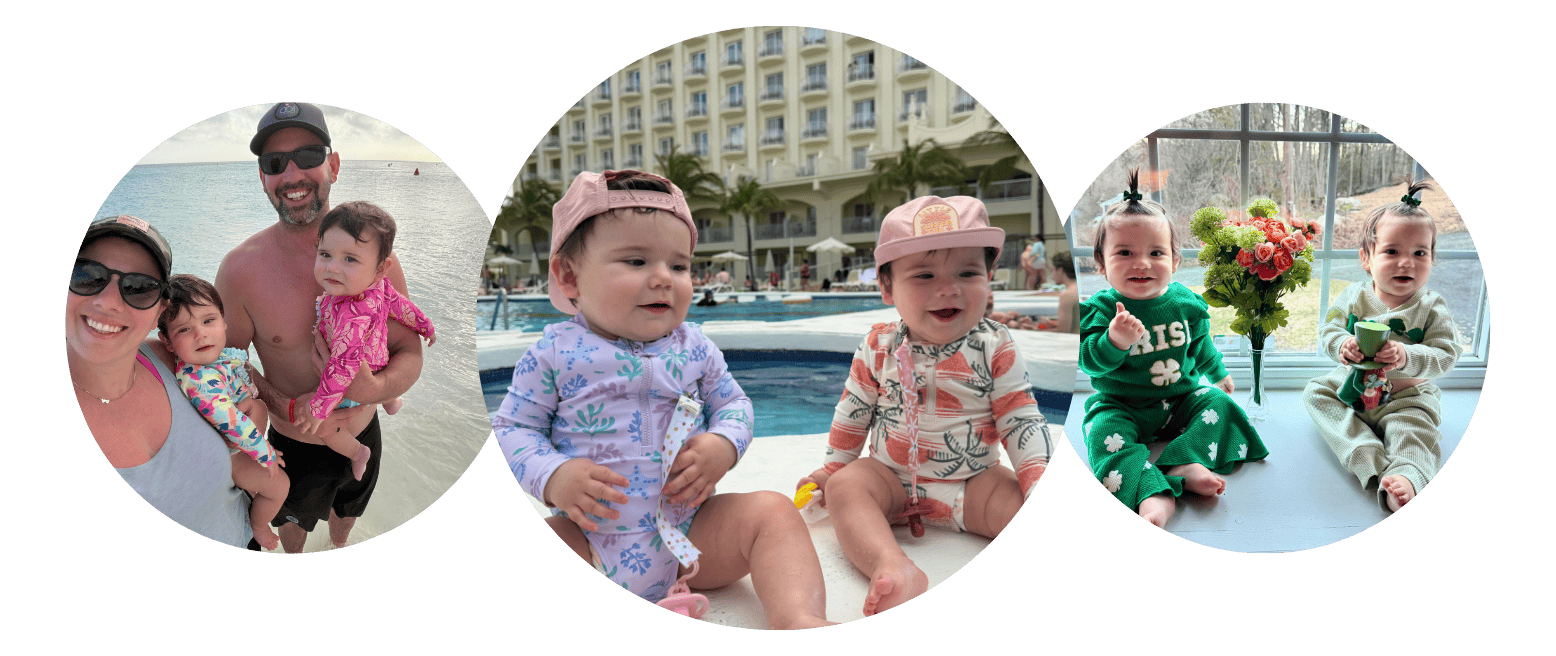
Photos: Kaitlyn, Travis, McKenna & Chelsea on vacation; the girls on St. Patrick's Day.
The Surprise of a Lifetime
During that first ultrasound appointment, something unexpected appeared on the screen. Their doctor noted there might be two babies. Kaitlyn took a few moments to process it. Travis's immediate reaction: "This is awesome!"
"I was in total disbelief," Kaitlyn says. She went home and did what most patients would do: she Googled 'HCG levels for twins'.
HCG, or human chorionic gonadotropin, is the hormone detected by pregnancy tests and monitored closely in early IVF pregnancies. HCG levels that rise particularly quickly or track unusually high can sometimes suggest a multiple pregnancy, though they aren't definitive on their own.
Kaitlyn's levels had been notably elevated. The ultrasound finding, while still a question mark at that first appointment, was starting to add up. Two weeks later, Dr. Joshua Hurwitz confirmed it during their second ultrasound.
Their single embryo had split, meaning Kaitlyn and Travis were expecting identical twin girls.
How does one embryo become identical twins?
Identical twins from IVF occur when a single fertilized embryo spontaneously divides into two. It's not caused by transferring two embryos, which is a common misconception.
In fact, identical twinning after a single embryo transfer happens in roughly 1 to 3 percent of IVF cycles, making it a genuine surprise even for clinical teams. It isn't something that can be predicted, planned for, or prevented. Sometimes, it simply happens.
One egg. One embryo. Two babies.
"Our one mighty blessing split into two, and we wouldn't change that for the world," Kaitlyn says.
Welcoming Twin Girls
McKenna and Chelsea were born on February 28, 2025. "Even miracles take a little time," Kaitlyn says, "and they truly are our miracle babies. Our hearts grew twice as much through this process."
The family just celebrated the girls' first birthday, and life, as Kaitlyn describes it, is full in the best possible way: "Our days are filled with chaos, but also with so much joy, love, happiness, and laughter as we watch McKenna and Chelsea grow and hit every milestone," she says. "They may be identical, but their personalities are very different, and it has been so fun to watch them each become their own person."
Over the past year, Travis and Kaitlyn have shared special moments with extended family, traveled with their girls, and started introducing them to their beloved Candlewood Lake. The life Kaitlyn and Travis once imagined, raising kids on the water, is finally becoming real.
"Being parents to twins isn't always easy," Kaitlyn says, "but it has been the most rewarding thing in our lives."
What Carried Them Through Infertility
Looking back now, Kaitlyn points to a few things that made a big difference during the hardest stretches of this journey. She encourages anyone else currently navigating infertility to plan ahead, keep moving, and stay connected to loved ones.
Creating a Support System
Kaitlyn holds immense gratitude for her mom Doreen, her sisters-in-law Alyssa, Jordan, Erinn, and Tiffany, and her mother-in-law Stacey, who served as a sounding board and never let them feel alone on their journey to parenthood.
"They always provided a listening ear and support when we needed it," she says.
Staying Active
Kaitlyn also found comfort in continuing to exercise throughout the process.
Physical activity, when appropriate and approved by your care team, can be a meaningful outlet during fertility treatment, helping to manage stress, support sleep, and provide a sense of normalcy when so much else feels out of your control.
Leaning On Your Partner
Then there was Travis: always quiet, steady, and certain. "He dealt with every emotion that arose with such grace," Kaitlyn says. She wants every partner reading this to know: you may not be the one physically going through treatment, but your presence matters profoundly.
Travis never let doubt take root. He never once suggested that IVF might not work. He never gave up on their dream. "He was truly my rock," Kaitlyn says.
She reminds couples that they are in this together: "Make sure you lean on each other. Even if you aren't the one physically going through this process, you are still experiencing a lot, both mentally and emotionally."
And to anyone who doubts whether they are doing the right thing, Kaitlyn offers a kind reminder: "Be patient - but never give up hope. Know that you are already amazing parents for all that you are willing to endure to grow your family."
Not sure where to start?
We're here to help. Take Illume's free fertility assessment and get personalized guidance on your next step.

It Takes a Village to Build a Family
Kaitlyn's final message is simple, but it carries the weight of everything she's lived through: "Everyone's story may look different, but the ending can be so beautiful."
She encourages anyone who is struggling to talk it out — with a partner, a family member, a friend, or even a stranger on the internet who just gets it. Find what brings you back to yourself, whether that's a walk, a podcast, a workout, or five quiet minutes alone. "Never lose your light," she says, "because the dark days won't last."
And to anyone who feels unseen or isolated right now: you are not alone.
A Note to Their Care Team
Kaitlyn and Travis close with some words of gratitude for Dr. Kucherov and their entire team at Illume Fertility:
"Your compassion through this entire process helped in more ways than you know. We felt so loved and supported by everyone. Although there were moments of doubt, you and your team never gave up on us or our desire to become parents, and we are forever grateful to you."
Today, they are parents to two girls — and they are just getting started. "We know this is only the beginning for us," Kaitlyn says. "We look forward to making more memories as a family and watching our daughters grow into the kind, loving, funny, beautiful girls that they are."

One embryo. Two babies.
How does that happen? Dr. Williams explains.

Not sure where to start?
Schedule a consultation to speak with a fertility specialist about your options.