
April 1st, 2026 | 14 min. read
At a glance
- → Ear seeds are small adhesive beads placed on pressure points on the outer ear
- → They are used as a needle-free form of auricular acupressure to support stress, sleep, pain, and overall regulation
- → During fertility treatment, ear seeds may help patients feel more grounded between acupuncture sessions
- → Ear seeds are supportive care, not a standalone fertility treatment, and should be placed by a licensed practitioner
If you've spotted tiny metallic beads on someone's ear and wondered what they were, you're not alone. Ear seeds have been having a moment, but the practice behind them is older than social media (by several decades). Here's what to expect if you're considering trying them.
In this article:
- What are ear seeds?
- The History of Auriculotherapy
- How Ear Seeds Affect the Nervous System
- Ear Seed Placement: Common Pressure Points
- What conditions are ear seeds used for?
- What happens during an ear seed appointment?
- Ear Seeds vs. Acupuncture
- Common Misconceptions About Ear Seeds
- FAQs About Ear Seeds
- Getting Ear Seeding Near You
What are ear seeds?
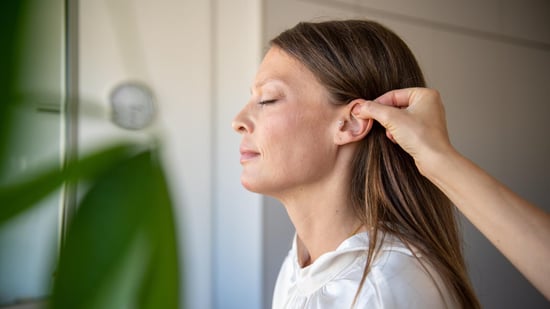
Ear seeds are small seeds, pellets, or beads applied to specific pressure points on the outer ear using a small piece of adhesive tape. They're held in place for several days, during which the wearer presses them gently a few times per day to stimulate the underlying point.
Common materials include vaccaria seeds (the traditional plant-based option), stainless steel or titanium beads, gold- or silver-plated pellets, and ceramic or magnetic beads. The material matters less than accurate placement and consistent stimulation.
Why is ear seeding suddenly trending?
The recent surge in social media content has brought ear seeds to a much wider audience, which is largely a good thing. But the trend has outpaced accurate information in some cases. A lot of what circulates online focuses on the aesthetic or DIY appeal without explaining how ear seeding actually works, or what it can (and can't) realistically do.
That's why we created this guide.
The History of Auriculotherapy
Ear seeds are rooted in auriculotherapy, a system of medicine focused on stimulating points on the ear to influence other parts of the body — think of it as ear acupressure.
This approach developed within traditional East Asian medicine and was later expanded in the West by French physician Dr. Paul Nogier in the 1950s. Nogier observed that the outer ear contains a map of the body resembling an inverted fetus, with different regions corresponding to specific organs and systems.
Under this framework, the earlobe corresponds to the head and brain, the middle ear to internal organs, and the upper ear to the lower body. This mapping system is now used in acupuncture and auricular acupressure treatments worldwide.
Ear seeds emerged as a way to stimulate these mapped points without needles, extending the reach of auriculotherapy beyond the clinic and into patients' daily lives.
How Ear Seeds Affect the Nervous System
In traditional East Asian medicine, ear points are locations where the body's vital energy, or qi, can be accessed and influenced. Stimulating them is thought to restore balance and support the flow of energy through the meridian system.
From a Western physiological standpoint, the mechanism centers on the autonomic nervous system, which controls functions like heart rate, digestion, and stress response.
A key anatomical feature is the auricular branch of the vagus nerve. The vagus nerve regulates the parasympathetic nervous system, sometimes called the "rest and digest" system, which helps lower stress hormones and promote a state of calm.
A 2022 review published in Frontiers in Psychiatry found that stimulating certain ear points may help reduce sympathetic nervous system activity, regulate cortisol levels, promote endorphin release, and influence pain signaling pathways.
Because ear seeds remain on the ear for several days, they provide continuous low-level stimulation that differs from the short, concentrated effect of a single acupuncture session. That sustained activation is part of what makes them a useful between-session tool.
Ear Seed Placement: Common Pressure Points Explained
Different ear points are selected depending on the goal of treatment. An experienced practitioner chooses points based on individual symptoms rather than a standard formula. That said, several points appear frequently across many protocols:
- Shen Men is often called the "spirit gate" and is one of the most commonly used points in auriculotherapy. Located in the upper triangular fossa of the ear, it is associated with calming the nervous system and frequently appears in protocols for stress, anxiety, and insomnia.
- The Endocrine Point is used to support hormone regulation and metabolic balance. It is often included in protocols related to reproductive health.
- The Sympathetic Point is thought to help regulate the autonomic nervous system and reduce pain. It appears frequently in protocols for chronic pain and stress-related conditions.
- The Uterus and Ovary Points are sometimes used in fertility-focused acupuncture protocols to support reproductive system function.
Fertility Acupuncture 101
Go beyond ear seeds – explore the benefits of traditional acupuncture and get a clear, science-based overview of how it can support fertility.

What conditions are ear seeds used for?
Ear seeds can be used as supportive therapy across a wide range of conditions. While they are not designed to be a standalone medical treatment, practitioners may incorporate them into care plans for:
- Stress and anxiety
- Fertility support and hormonal balance
- Chronic pain (including back pain and headaches)
- Insomnia and disrupted sleep
- Nausea from chemotherapy, surgery, or pregnancy
- Digestive issues
- Menstrual irregularities
- Substance use recovery
- Postoperative discomfort
The breadth of applications reflects the range of body systems that auricular points are thought to influence. In practice, stress management and pain relief are the most common reasons patients use them.
Ear Seeds for Stress & Anxiety
Stress management is one of the most well-supported applications for ear seeds, both in clinical practice and in the research literature.
The Shen Men point is a primary target for calming the nervous system and appears in many treatment protocols regardless of the primary complaint, because managing stress is foundational to overall health.
How Ear Seeds for Anxiety Work
Part of the practical appeal is that ear seeds work continuously. Pressing them during a stressful moment, before a medical appointment, or at the end of a long day can become a grounding habit that extends the benefit of in-clinic treatment into everyday life.
For people managing ongoing anxiety, that kind of low-effort daily touchpoint can be genuinely useful.
What the research says:
A 2023 meta-analysis of 12 studies found that auriculotherapy was significantly more effective than control conditions across multiple stress-related measures, including subjective stress, blood pressure, and heart rate variability.
In 2022, a randomized controlled trial also found that auricular acupressure measurably reduced cortisol levels and increased serotonin levels in participants, pointing to a real physiological effect rather than placebo alone.
Ear Seeds & Fertility Treatment
Many fertility patients incorporate acupuncture into their care as part of a broader integrative approach, and ear seeds are often used to extend that support between sessions.
Acupuncture continues to be studied for its supportive role in fertility treatment, with research exploring its effects on stress hormone regulation, blood flow to reproductive organs, and hormonal balance.
How Ear Seeds Help During Fertility Treatment
Fertility treatment is physically and emotionally demanding, and managing stress throughout the process is considered an important part of supporting overall wellbeing. Ear seeds offer a practical, low-effort way to maintain that support during the stretches of time between fertility acupuncture appointments.
Points commonly used in fertility-focused protocols include the endocrine point for hormone regulation, the uterus and ovary points for reproductive system support, and Shen Men for managing the anxiety and emotional weight that often accompanies treatment.
For patients going through IVF or other assisted reproductive procedures, ear seeds aren't a treatment in themselves, but they can be a meaningful part of staying regulated and engaged with their care between visits.
What the research says:
A review published in Frontiers in Public Health found that the proposed mechanisms of acupuncture in IVF include enhanced hormonal balance, reduced uterine contractions, increased blood flow to the uterus and ovaries, and lower stress hormone activity.
An overview in the Journal of Alternative and Complementary Medicine also noted that acupuncture may support live birth rates by working through these same physiological pathways, though results across studies are mixed and more research is needed.
What happens during an ear seed appointment?
Receiving ear seeds during an acupuncture visit is a quick process.
The acupuncturist first evaluates your symptoms and identifies which points are most appropriate for your goals. They clean the ear with alcohol, locate the target points, apply the adhesive seeds, and press each one gently to 'activate' it.
The whole process typically takes just a few minutes and is usually done at the end of a regular acupuncture session. You'll leave with the seeds already in place and instructions for how to care for them at home.
How to Press Ear Seeds Correctly
After your appointment, you'll be instructed to press each seed two to three times per day for roughly 10 to 30 seconds per point. Pressing them at consistent times, such as morning, midday, and before bed, helps establish a routine and ensures regular stimulation.
You don't need to press hard. Gentle, firm pressure is enough to activate the point. You may notice mild tenderness or a dull warmth when pressing, which is normal and generally a sign that the point is responding. If pressing a seed causes sharp or persistent pain, remove it.
How Long Ear Seeds Stay In
Ear seeds typically remain in place for three to five days. After that, the adhesive tends to weaken and the seeds become less effective. They should be removed sooner if the skin underneath becomes irritated, if the adhesive begins to peel, or if any discomfort develops.
Most practitioners recommend giving the ear a short rest before applying a new set, particularly when using ear seeds regularly over a longer period. If you're receiving them as part of ongoing acupuncture care, your practitioner will advise on the right schedule for your situation.
Who Should Not Use Ear Seeds
Ear seeds are generally safe for most people, but there are situations where caution is warranted. They may not be appropriate for people with open wounds or active infections on the ear, a known adhesive allergy, or certain skin conditions affecting the ear.
If you are pregnant, undergoing active medical treatment, or managing a chronic health condition, it's always best to consult with your care team before starting. And if you're using ear seeds as part of a fertility treatment protocol, let your acupuncturist and fertility doctor know so they can coordinate your care appropriately.
Is acupuncture right for me?
Get a clear overview of what traditional acupuncture involves and whether this holistic therapy may benefit you.
Ear Seeds vs. Acupuncture
Ear seeds and acupuncture target the same auricular pressure points, but they work differently.
Acupuncture delivers precise, concentrated stimulation through fine needles inserted directly into specific points during a session. Ear seeds apply gentler, sustained pressure to the same points over several days without breaking the skin.
Acupuncture tends to produce a stronger immediate effect, while ear seeds offer lower-level but continuous stimulation over time. They're best understood as complementary rather than interchangeable. Most practitioners use ear seeds as an extension of acupuncture treatment, not a substitute for it.
Key takeaway: For people who are needle-averse, ear seeds can provide some of the same auricular stimulation without needles, though the clinical effect is different.
Common Misconceptions About Ear Seeds
Myth: Ear seeds are just a TikTok trend.
The recent surge in social media content about ear seeds has led some people to dismiss them as a passing wellness fad. But auriculotherapy has been practiced for decades in both traditional East Asian medicine and Western integrative medicine.
What's new is the audience, not the practice.
Myth: Results are immediate.
Ear seeds don't produce instant relief, and expecting them to can lead to frustration. Like most complementary therapies, the benefits tend to build gradually with consistent use.
Some people notice a shift in stress levels or sleep quality within the first few days. Others find that effects become more apparent after multiple rounds of treatment. Patience and consistency matter more than any single application.
Myth: Any ear seed kit will work the same as a clinical application.
DIY ear seed kits have made auricular acupressure more accessible, which is largely a good thing. But accurate placement is what makes ear seeds effective.
A kit applied without any real understanding of auricular anatomy, or to the wrong points for your specific situation, is unlikely to produce meaningful results.
Myth: Ear seeds are only for people who are afraid of needles.
While ear seeds do appeal to needle-averse patients, they aren't designed primarily for that purpose. In clinical practice, acupuncturists use them for all patients as an extension of treatment. The sustained stimulation they provide between sessions serves a distinct purpose from acupuncture itself.
FAQs About Ear Seeds
Do ear seeds actually work?
Ear seeds are being studied in oncology, surgical recovery, and addiction medicine, among other areas. Studies on auricular acupressure have shown potential benefits for chronic pain, anxiety, insomnia, and postoperative nausea, though many studies are small and methodology varies.
Most experts consider ear seeds a low-risk complementary therapy appropriate for use alongside conventional medical care, not as a replacement for it. For now, the honest answer is that ear seeds are worth exploring - for the right patient, with realistic expectations.
What are ear seeds made of?
Traditional ear seeds are made from the dried seeds of the vaccaria plant, a flowering herb used in traditional East Asian herbal medicine. Modern versions include stainless steel or titanium beads, gold- or silver-plated pellets, and ceramic or magnetic options, all attached to the ear with a small adhesive backing.
People with metal allergies may want to opt for vaccaria seeds or ceramic beads.
How long should ear seeds stay in?
Ear seeds should typically last around three to five days. They should be removed sooner if the skin becomes irritated, the adhesive begins to peel, or any discomfort develops. Give your ear a brief rest before applying a new set.
Do ear seeds hurt?
They shouldn't. Most people feel mild pressure or slight warmth when pressing the seeds. Sharp or persistent pain is a sign to remove them. Some points are naturally more tender than others depending on your current health state, which is normal.
Do ear seeds help with anxiety?
A 2023 meta-analysis of 12 studies found auriculotherapy significantly reduced stress and anxiety markers compared to control conditions. Individual results vary, and ear seeds work best as one part of a broader anxiety management approach.
Are ear seeds safe during IVF?
Many fertility patients use ear seeds throughout IVF cycles without any issues. Because they're non-invasive and drug-free, they're generally considered compatible with assisted reproductive treatment. Just let your fertility doctor and acupuncturist know you're using them so your care can be coordinated appropriately.
Can I apply ear seeds myself?
Yes, with a few important caveats. Ear seed kits are widely available and straightforward to use once you understand the basics. The challenge is accurate point location, which isn't easy without training.
Most practitioners recommend receiving ear seeds from a licensed acupuncturist first, then applying them at home between sessions once you understand which points are relevant for your goals. If a partner or friend can help you, it's often much easier than doing it yourself.
How often should I press my ear seeds?
Two to three times per day for 10 to 30 seconds per point. Pressing them at consistent times, such as morning, midday, and before bed, helps establish a routine and ensures the points are being regularly stimulated. Gentle, firm pressure is all that's needed.
Are ear seeds the same as ear acupuncture?
They target the same points but work differently. Ear acupuncture uses fine needles inserted during a session for precise, concentrated stimulation. Ear seeds apply gentle, sustained pressure over several days without breaking the skin. The two are often used together rather than in place of each other.
Ready to try acupuncture?
Our fully-licensed practitioners offer convenient access to care for individuals across Connecticut and New York.

Getting Ear Seeding Near You
For many fertility patients, ear seeds and acupuncture offer something truly valuable: a sense of agency and the ability to do something. In a process that can feel largely out of your hands, having a small, tangible way to support your body and mind matter.
If you're curious about trying ear seeds and live in Connecticut or New York, one of our licensed acupuncturists can assess your needs and place seeds on the points most relevant to your goals.
Not a fertility patient? Our acupuncture services are also open to the wider community!
At Illume Fertility, our acupuncturists incorporate ear seeds into care plans for patients preparing for IVF, managing stress during treatment, or seeking gentle support between appointments — one of many integrative tools offered alongside your medical care.
Ready to explore? Learn more about our Integrated Fertility & Wellness program.

New to fertility acupuncture?
Ear seeds are just one technique. Learn how acupuncture helps support hormone balance, blood flow, and better outcomes.