
June 3rd, 2026 | 8 min. read
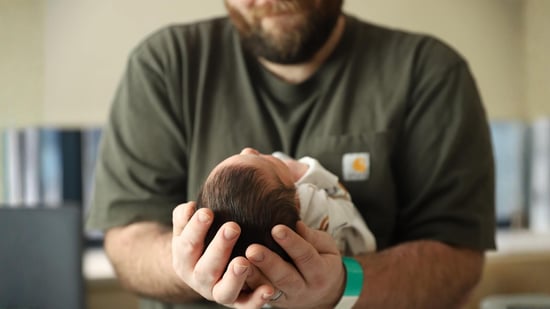
Every year, Father's Day arrives with its greeting cards and grilling plans and social media tributes. And every year, for the people sitting in the long middle of a fertility journey, that Sunday in June can feel like it belongs to a world just slightly out of reach.
This article is for the hopeful dads-to-be who show up to every appointment, who research what their partner's test results mean, who hold their person's hand through ultrasounds and wait for phone calls they don't know how to prepare for.
At a glance
- → Partners in fertility treatment often carry significant emotional weight that goes unacknowledged, even by themselves
- → The “support role” does not make the experience less important; hopeful dads-to-be are deeply affected by every outcome, delay, and milestone
- → Father’s Day during infertility or fertility treatment can be one of the hardest and most quietly meaningful days of the year
- → Recognizing and validating the partner experience can strengthen communication, reduce isolation, and support the whole family unit
The Role Nobody Prepares You For
There's a version of the fertility journey story that goes like this: one person is the patient, one person is the support system. The patient goes through the physical process. The partner shows up, encourages, and waits.
But the reality is much more complicated and tender than that framing allows.
Partners in fertility treatment, particularly male partners navigating the road toward fatherhood, often occupy a strange emotional space. They are present for everything and centered in almost nothing.
The appointments are scheduled around their partner's cycle. The medications are administered to their partner's body. The consultations speak most directly to their partner's physiology. And yet they are there, absorbing all of it, processing their own grief and hope and fear with relatively little scaffolding to support them.
What the Research Says
Research consistently shows that many male partners experience real and significant psychological distress during fertility treatment.
A systematic review published in the Journal of Clinical Medicine found that both men and women undergoing IVF deal with meaningful levels of anxiety, depression, and reduced quality of life throughout the process, with the most stressful points clustered around retrieval, fertilization results, and the waiting period before a pregnancy test.
A prospective study published in Human Reproduction found that both partners' emotional responses were closely tied to treatment outcomes, with men's reactions shifting significantly depending on whether the cycle resulted in pregnancy.
And yet the clinical and social infrastructure around fertility care has historically been far more focused on the person going through treatment than on the person going through it beside them. This is starting to shift. But not fast enough for the many partners who are still quietly carrying something they haven't been given adequate support to navigate.
What Hopeful Dads Are Actually Holding
When you ask partners to describe what it feels like to support someone through fertility treatment, certain words come up again and again: helpless, invisible, strong, scared, grateful, guilty.
The guilt, in particular, is something that doesn't get talked about enough.
When a couple receives a diagnosis related to the male partner's fertility, whether that's low sperm count, poor motility, or the need for surgical intervention, that partner often internalizes a profound sense of responsibility for the path they're now on together.
They may minimize their own feelings because they believe their partner is "going through more." They may throw themselves into logistics and research because action feels more useful than emotion. They may go months without anyone asking how they're doing.
Research published in Human Fertility found that infertility-related distress in male partners is connected to a range of psychosocial factors, including self-esteem, relationship dynamics, and deeply internalized ideas about masculinity.
In other words, many men are not just grieving a difficult situation. They're also navigating the pressure to appear unaffected by it.
Even when the diagnosis has nothing to do with the male partner's fertility, the emotional weight is still real. Watching someone you love go through hormone injections, egg retrievals, transfers, and the particular agony of a two-week wait is not a passive experience.
You grieve the failed cycles. You hold your breath waiting for pregnancy test results. You recalibrate your hope over and over again in ways that take a quiet toll.
Then Father's Day arrives.
A Holiday That Lives in the Tension
There may be no single day of the year that crystallizes the fertility journey partner experience quite like Father's Day does.
For some hopeful dads-to-be, it's a day that feels impossibly close and impossibly far at the same time. They are already, in many real and meaningful senses, doing the work of a committed, devoted future father.
They are showing up. They are learning. They are planning and hoping and advocating. The identity is already taking shape. The title just hasn't arrived yet.
For others, Father's Day is simply hard. It surfaces grief or frustration that usually stays submerged. It makes visible the gap between where they imagined they would be and where they actually are. Scrolling through social media on that Sunday can feel like running a gauntlet of everything you're working toward and don't yet have.
Both of these experiences are valid. Both can exist in the same person on the same day.
What partners often need most on Father's Day isn't a workaround or a distraction. It's acknowledgment. It's someone, anyone, saying: what you are doing is real. What you are feeling is real. The road you are walking with your person is hard, and you are doing it with more love and more steadiness than you probably realize.
The Things That Often Go Unseen
Throughout a fertility journey, many partners take on responsibilities they never expected to carry. Let's name some of them, because they deserve recognition.
They Educate Themselves
Hopeful dads-to-be become familiar with fertility clinic terminology not because anyone asks them to, but because they want to understand.
They read the clinic handouts. They track the cycle calendar. They know what to expect at appointments. They try to show up informed because it's one of the few ways they can contribute to a process where their body isn't at the center of it.
They Manage Logistics
Fertility treatment involves an enormous amount of coordination: medication orders, insurance calls, appointment scheduling, pharmacy pickups. Many partners absorb as much of this operational burden as possible, not because it was assigned to them, but because reducing friction for their person is a form of love they know how to offer.
They Offer Support
When their partner is in the depths of a hard cycle or devastated by a negative result, they find ways to stay steady (even when they don't feel it). They learn when to talk and when to sit in silence. They learn that sometimes the most important thing they can do is simply not leave the room.
They Advocate
In appointments. With insurance companies. With family members who don't understand why this is taking so long or why it costs this much. They stand beside the person they love in conversations that shouldn't have to happen.
None of this is invisible to the person they're doing it for. But it often goes unnamed in the broader conversation about what fertility treatment looks like for couples.
You're in this together.
Navigating fertility treatment with your partner can be challenging. Illume's Partner Resources hub has guidance on communication, intimacy, and finding a counselor who gets it.

What We Can Do
Research has shown that partner support plays a significant role in how both people move through the experience, and that the partner's own coping patterns directly affect the other person's ability to cope. In other words, caring for the partner isn't just kind. It can actually influence how the whole family unit navigates treatment.
If you're a friend or family member of a couple going through fertility treatment, consider that your next check-in doesn't have to be directed only at the person who is the identified patient. "How are you doing with all of this?" asked genuinely to the partner can open something that might otherwise stay shut.
And if you are the hopeful dad-to-be reading this: you are allowed to have needs in this process. You are allowed to say when days are hard, that you're tired, that you're scared, that Father's Day carries more weight this year than you know how to explain.
Important reminder: Seeking support for yourself doesn't diminish your ability to support your partner. It only expands it.
How We Support Partners
At Illume Fertility, we know this journey belongs to both of you. During consultations, we make it a point to check in with both partners, ask how they're coping, and offer space for each person involved to ask questions.
Community Spaces
Our free Partner & Men's Support Group, led by therapist Kevin Felix, LMSW, is a virtual space built specifically for partners navigating the fertility experience.
Whether you're trying to figure out how to show up for your person, working through your own emotions, or simply looking to hear from others who get it, this group offers guided discussion, communication tools, and a nonjudgmental space to process what you're carrying.
Note: This group is open to partners of all gender identities and sexual orientations.
Mental Health Resources
We also maintain a mental health referral network of providers who specialize in the emotional side of fertility treatment, including therapists who offer couples counseling. If you and your partner want dedicated support for navigating this road together, we can connect you with someone who understands the terrain.
You don't have to process this quietly. Help is here when you're ready for it.
A Final Reminder for Hopeful Fathers
You may be in your first cycle or your fifth. You may be weeks away from an embryo transfer or years into a journey that keeps getting rerouted in ways you didn't plan for. You may have already become a parent with the help of fertility treatment and remember, with great clarity, what it felt like to be where you are now.
Wherever you are: the love you are already showing is the core of fatherhood, even before the title. The presence, the steadiness, the willingness to keep going through something that is genuinely hard. Those aren't warm-up acts for the real thing. They are the real thing.
Father's Day might feel tender. It might feel hopeful. It might feel like both at once. That's okay. You're already doing the hard work. The world just hasn't caught up with you yet.

You both matter.
Whether you're just starting or deep into treatment, our team meets both of you where you are. Partners are welcome at every appointment and every conversation.
