
Search for topics or resources
Enter your search below and hit enter or click the search icon.
Learn how PGT works, what it can and cannot tell you, and whether it may be right for you.
Preimplantation genetic testing (PGT) is an optional laboratory test that can be performed as part of an in vitro fertilization (IVF) cycle.
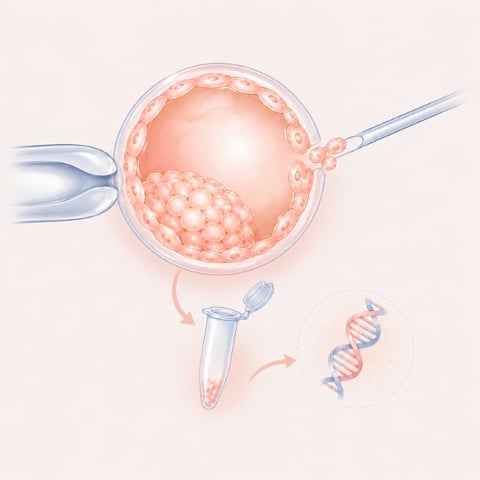
Once an embryo reaches the blastocyst stage (Days 5-7 of development), a few cells can be removed from its outer layer for testing while the embryo is safely stored at Illume Fertility.
PGT-A screens chromosome number, PGT-M tests for a specific single-gene condition, and PGT-SR looks for unbalanced chromosome material. PGT does not change an embryo’s DNA, but it tests only a small sample of cells and cannot guarantee implantation, pregnancy, or a healthy baby.
Note: PGT is the current umbrella term for testing previously called preimplantation genetic diagnosis (PGD) or preimplantation genetic screening (PGS).

Screens embryos for extra or missing chromosomes

Screens embryos for a specific inherited condition

Screens embryos for unbalanced chromosome material
While not every patient will need or choose to pursue PGT, it can provide useful information in specific situations to help families move forward with greater confidence.

Adds genetic information to embryo development and grading when deciding which embryo may be considered for transfer.
Helps identify the embryos that are less likely to be affected by the specific inherited condition included in PGT-M testing.

Identifies embryos with extra or missing chromosome material related to a parent’s known structural rearrangement.

May help some patients avoid transferring embryos with chromosome differences that could prevent implantation or cause miscarriage.
Preimplantation genetic testing (PGT) is not necessary for everyone undergoing IVF. You may consider it if:
Maternal age, pregnancy loss, previous unsuccessful IVF treatment, donor eggs, or gestational surrogacy may prompt a conversation about PGT-A, but none automatically means testing will be beneficial.
Your reproductive endocrinologist and genetic counselor can help you weigh the potential value, limitations, cost, and possibility of uncertain results.

If you choose PGT, testing will be completed as part of your IVF cycle.
Your care team will help you understand the timeline, expected costs, and potential decisions involved before testing begins.






PGT is highly accurate for the specific chromosome or genetic finding it is designed to assess, but no test is 100% accurate. Reliability varies by the type of PGT, the laboratory method used and the quality of the cell sample.
PGT analyzes DNA from a small sample of placenta-forming cells, not the entire embryo. This is why some findings, particularly mosaic results, require careful interpretation with a genetic counselor.
Embryo biopsy is generally considered safe when performed by experienced embryologists, although biopsy, freezing and thawing carry a small risk of damaging an embryo.
Your physician and genetic counselor will help you understand your results and any recommended next steps. PGT does not guarantee a healthy pregnancy or replace recommended prenatal testing.

Illume's in-house genetic counseling team provides clear, compassionate, non-directive guidance before and after PGT to help you understand what a test may reveal, how results are classified, and which questions to discuss with your physician.

Jamie is a board-certified genetic counselor with over 20 years of experience in reproductive genetics.

Anthony is a board-certified genetic counselor known for his calm, thoughtful approach to patient care.