
Genetic risks nearly made a Connecticut couple rule out biological children until an OB-GYN pointed them towards IVF.
October 30th, 2026 | 14 min. read

Medically reviewed by Joshua M. Hurwitz, MD
After losing his mother and two aunts to cancer, Colin learned he carried the same inherited BRCA2 variant, giving his future children a 50% chance of inheriting it.
He and Laura questioned whether having biological children was right for them until a conversation with Laura's OB-GYN introduced them to a new option: in vitro fertilization (IVF) with preimplantation genetic testing for monogenic conditions (PGT-M), which could help them reduce the risk of passing down the variant.
Meet Laura & Colin
When they met in 2019, Laura and Colin quickly realized they wanted the same things out of life, including a family of their own. Both living in the Danbury area of Connecticut, they began building a future together, never imagining the difficult decisions they would soon face.
"When I met my husband, I knew I wanted to have children with him some day," Laura says. "It’s true what they say, when you know you know, and we quickly knew we wanted to be together and have a family."
A Difficult Discovery
Early in their relationship, Colin learned that his half-sister had tested positive for the same BRCA2 variant carried by his late mother and aunts. Encouraged by Laura, he underwent genetic testing in 2020 and learned that he carried the variant too.
"After looking into it further and realizing we would have a 50/50 chance of passing that gene on to our future children, we were devastated," Laura says. "Even as a nurse, I had my doubts, especially knowing how devastating cancer had been to Colin's family."
The news left them questioning the future they had pictured together. They still wanted children, but the possibility of passing down a hereditary cancer risk made the decision far more complicated.
Understanding BRCA1 & BRCA2
BRCA stands for "BReast CAncer gene," but the name can be confusing. Everyone has BRCA1 and BRCA2 genes, with one copy of each inherited from each parent. These genes aren't bad on their own. They actually help repair damaged DNA and protect against cancer.
But certain changes in these genes, called mutations or variants, can keep them from working properly and raise the risk of cancer. When someone talks about "passing down BRCA," they mean passing down a gene change that increases cancer risk.
Inheriting that change can increase cancer risk, but it does not mean cancer is certain.
BRCA1 and BRCA2 are among the best-known genes linked to inherited cancer risk. But changes in dozens of other genes can increase cancer risk, too.
How BRCA Variants Are Inherited
A harmful BRCA variant can pass from either genetic parent to a child of any sex. When one parent carries a variant in one copy of the gene, each child has a 50% chance of inheriting it. For Laura and Colin, that possibility made family planning feel much more complicated.
Testing for an inherited BRCA variant involves a blood or saliva sample. A clinician can help determine whether it makes sense based on your personal and family history, including whether a relative has a known variant, as Colin’s half-sister did.
BRCA2 Cancer Risk Compared With the General Population
Colin’s results carried meaning beyond the family he and Laura hoped to build. Learning about his BRCA2 variant gave him information to discuss with his healthcare team, including options for cancer screening and prevention.
Harmful BRCA2 variants raise the risk of several cancers, including breast, ovarian, prostate, and pancreatic cancer. The table below compares selected cancer risks with those in the general population.
These figures show why knowing about a BRCA2 variant matters. They cannot predict whether or when a particular person will develop cancer.
Source: National Cancer Institute. Note the different age ranges. Breast cancer in women and ovarian cancer figures describe lifetime risk. Prostate cancer figures extend to age 80, and breast cancer in men figures extend to age 70.
BRCA Testing in Children
For parents thinking about inherited risk, it is natural to wonder whether a child could be tested after birth. Medical guidelines generally recommend waiting until adulthood for predictive BRCA1 and BRCA2 testing, since related cancers are very unlikely in childhood and any risk-reduction measures are intended for adults.
A child who inherited Colin’s variant would face those conversations later in life. Knowing what his family had already been through, Laura and Colin wanted to understand whether they had another option. Testing embryos before pregnancy through PGT-M offered a different way to address that concern.
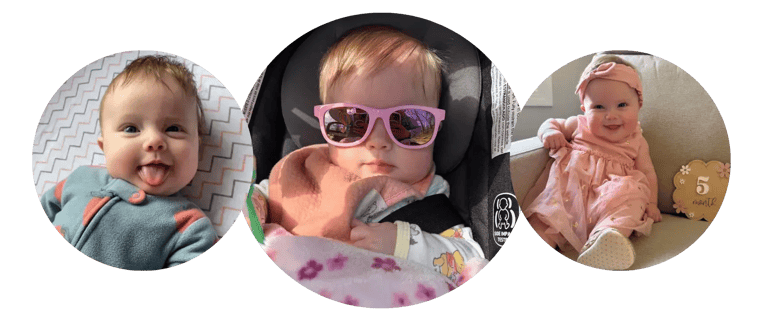
Meet Kayleigh, the long-awaited baby girl at the heart of Laura and Colin’s story.
Finding Their Path to Parenthood
"After having a heart to heart with my OB-GYN [about our concerns], I was referred to Illume Fertility and met with Dr. Joshua Hurwitz to discuss our options," Laura says.
During that appointment, they learned about combining in vitro fertilization (IVF) with preimplantation genetic testing for monogenic conditions (PGT-M). This type of testing looks for a specific inherited variant involving a single gene, such as the BRCA2 variant in Colin’s family.
PGT-M is not limited to inherited cancer risk. It can be used to test embryos for many other inherited single-gene conditions, including cystic fibrosis and sickle cell anemia. A genetic counselor can help determine whether PGT-M is an option for a family’s specific condition.
"PGT-M is a great option for people who carry genetic mutations that they do not want to pass on to their children," Dr. Hurwitz says. "IVF allows us to create and test embryos to see which embryos carry the genetic mutation and which do not, and then only transfer ones that are not affected."
For Laura and Colin, that conversation changed what they understood to be possible. They were relieved to learn that IVF with PGT-M could help them pursue biological parenthood and reduce the chance of passing down Colin’s familial BRCA2 variant.
Genetic Counseling Built Into Your Care
Learning that you carry an inherited variant can bring up difficult questions that extend far beyond the initial result, from what it means for your children to how testing could affect your family-building timeline.
Illume’s in-house genetic counselors help patients work through those questions, reviewing family history and genetic reports and explaining what testing can and cannot tell them.
Our counselors work directly with your reproductive endocrinologist, a physician who specializes in fertility care, and the outside genetics laboratory to connect those findings to your treatment plan. You receive guidance before testing and when results arrive, including non-directive support with decisions about which embryos to consider for transfer.
The goal is to give you clear information and a compassionate space to make choices that fit your values and family-building goals. PGT-M is just one option to discuss, and the decision to pursue it (or not) always remains with you.
Preparing for PGT-M
Before embryos can be tested, the genetics laboratory develops a custom test, sometimes called a "probe," designed to identify the family’s specific variant. This process begins with a case review to determine whether the lab can develop a test that will work for that family.
To develop that test, the laboratory reviews genetic reports and collects DNA samples from the people providing eggs and sperm. Samples from other relatives are sometimes needed to help the laboratory track how the variant has passed through the family.
The requirements vary, and your genetic counselor can help you understand which information and samples are needed for your case.
This preparation takes time, often a few weeks to a few months, depending on the family’s circumstances and the laboratory’s process. ASRM guidance advises completing test development before IVF whenever possible, so patients know whether testing is feasible before beginning treatment.
If the laboratory cannot develop a reliable test, your Care Team can help you explore what that means for your plans.
For Laura and Colin, this stage took longer than they had expected. Delays related to the genetic testing process extended their timeline, adding another period of uncertainty as they waited to move ahead.
Explore Embryo Testing
Learn how PGT-M differs from other embryo tests, what testing can tell you, and which questions to discuss with your Care Team.

How IVF Makes Embryo Testing Possible
The IVF process begins with fertility medications that help the ovaries mature multiple eggs.
Throughout this stage, regular monitoring appointments give your Care Team a chance to track the ovaries' response through blood work and ultrasounds and determine when the eggs are ready for retrieval.
During egg retrieval, a short procedure performed under sedation, a physician collects the eggs and passes them to the embryology team for fertilization with sperm. Specially trained embryologists then monitor any developing embryos over the following days. Embryos that reach the blastocyst stage, usually around days 5 to 7, can be considered for biopsy.
How does PGT-M reduce the risk of passing down BRCA2?
At the blastocyst stage, an embryo has both an outer layer of cells, which develop into the placenta, and an inner group of cells that can develop into the fetus. To perform a biopsy, an embryologist carefully removes a small sample from the outer layer for genetic testing.
The embryo itself is then frozen through a process called vitrification and stored at Illume Fertility while the sampled cells are sent to an outside genetics laboratory for analysis.
PGT-M looks for the specific genetic variant identified in the family. For Laura and Colin, this meant testing embryos for Colin's inherited BRCA2 variant. The results help identify embryos predicted to carry the variant and those predicted not to carry it.
Note: Some PGT-M results can be inconclusive. Your genetic counselor explains the findings, then you and your physician discuss which embryos to consider for transfer.
How accurate is embryo testing?
PGT-M is highly accurate at identifying specific inherited genetic variants. For PGT overall, ESHRE guidelines describe error rates as low as 1–3%. This figure is not specific to PGT-M, and accuracy varies by the condition, testing method, and laboratory.
PGT-M can substantially reduce the chance of passing down a specific inherited variant, but it cannot rule out every genetic condition, guarantee a successful pregnancy or healthy child, or eliminate all future cancer risks.
How does PGT-A compare to PGT-M?
Preimplantation genetic testing for aneuploidy (PGT-A) screens embryos for extra or missing chromosomes. Unlike PGT-M, which targets a known genetic variant, PGT-A evaluates chromosome copy numbers to help guide embryo selection.
PGT-A has different limitations. It analyzes only a small sample of cells, which may not fully represent the entire embryo. This is particularly relevant when an embryo has a mixture of cells with different chromosome patterns, known as mosaicism. For this reason, there is no single accuracy percentage that applies to every PGT-A result.
The ASRM guidance on PGT-A explains these limitations in greater detail.
It's important to understand that neither test can guarantee a successful pregnancy or a healthy child. Even after PGT-M, prenatal diagnostic testing, which may include options like chorionic villus sampling (CVS) or amniocentesis, is recommended to confirm the results.
3 IVF Cycles, 1 Embryo Transfer
For Laura and Colin, reaching the embryo transfer stage took three IVF cycles and multiple egg retrievals. Each cycle left them with only a small number of embryos to send for testing, making the wait for results another emotionally challenging part of the process.
Not every retrieved egg fertilizes, and not every developing embryo reaches the stage needed for biopsy. For a parent carrying one copy of a harmful BRCA2 variant, each embryo has a 50% chance of inheriting it. That does not mean the results will divide evenly in any particular cycle, especially when only a few embryos are available to test.
Together, these factors can affect how many embryos are available to consider for transfer.
Navigating the Unknowns
As Laura and Colin discovered, some patients need more than one egg retrieval, and IVF treatment does not always produce an embryo suitable for transfer. Talking through these possibilities with your physician and genetic counselor can help you prepare for the uncertainty and decisions that come with this process.
"The hardest part of the IVF process was the unknown and factors out of my control," Laura admits. "Being a nurse, I have rarely been a patient; it is definitely hard to be on the other side of things. I’d much rather help people than need the help myself."
After three IVF cycles, Laura and Colin were finally able to move ahead with their first embryo transfer in February 2025. Thankfully, that transfer was successful, and on November 3, 2025, they welcomed their healthy baby girl, Kayleigh.
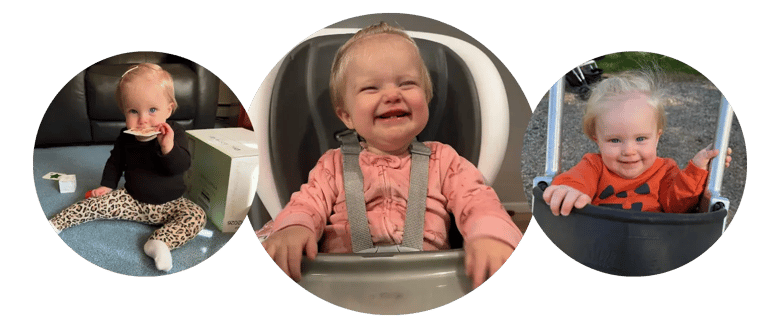
A few special moments from Kayleigh's first year.
On Becoming Parents
Reflecting on life as a family of three, "we're really enjoying each of her milestones," Laura says. For a couple who had spent so much time waiting and wondering, those little moments have meant a great deal.
Some milestones took a little extra work—Kayleigh had plagiocephaly, a flattening of the head, and wore a corrective helmet and attended physical therapy for a short time. "When she graduated from both and was able to crawl, it brought tears to our eyes!" Laura says.
Today, Kayleigh is always on the move and developing her own little personality. Her parents are excited to experience more firsts together as she continues to grow.
Why They Share Their Story
One of the biggest surprises, Laura says, was discovering how many people around her had been through fertility treatment. As she opened up about her experience, she learned that close friends and coworkers understood more of what she was going through than she had realized.
She and Colin leaned on each other throughout the process, but sharing with others helped her find a wider network of people who had been through IVF. "I never expected to be part of this community, but I’m so thankful to have found it," Laura says. "I met some of the most beautiful people who also shared the same journey. We still talk to this day!"
Laura encourages other patients to do the same when they feel ready: "Reach out to others and share your story: the good, the bad, and the ugly." For her, talking about treatment brought much-needed connection and comfort during a chapter she and Colin never expected to face.
That experience is part of why they've chosen to share their journey publicly. They know how isolating it can feel to question whether the family you imagined is possible, and they hope their story reaches someone facing similar decisions.
Find Support Along the Way
Fertility treatment can feel isolating. Connect with others who understand through Illume’s free support groups and events, with space to share experiences and ask questions.

Exploring Your Own Options
Learning about an inherited cancer risk can change how you picture your future family. Laura and Colin know firsthand what it feels like to want children and question how to move ahead. Meeting with Dr. Hurwitz helped them understand a path they hadn’t known was available.
If you or your partner carries a known inherited variant, Illume's physicians and in-house genetic counselors can review your family history and test results, explain potential options, and help you understand what treatment involves.
Our financial coordinators help you work through anticipated treatment costs and insurance questions, including which IVF and PGT-M services are billed separately.
Illume's free insurance coverage guide is a great way to start exploring your benefits, and our Finance Hub offers detailed guidance about everything from navigating costs to finding IVF grants and medication discounts.
You don’t need to show up to your first fertility appointment with decisions about IVF or embryo testing already made. Our first conversation together simply gives you room to ask questions, talk about your concerns, and learn what is possible for your own family.
When you're ready to take the next step, Illume Fertility is here to help.

Considering IVF treatment?
If you're just starting to explore your fertility options, understanding how IVF works can help demystify the process.


Let's Talk About Your Options
Have questions about IVF, genetic testing, or your own family's health history? Meet with an Illume Fertility specialist to learn what options are available to you.